
Rwanda cuts poverty from 39.8% to 27.4% in seven years – National survey
By The Inspirer.
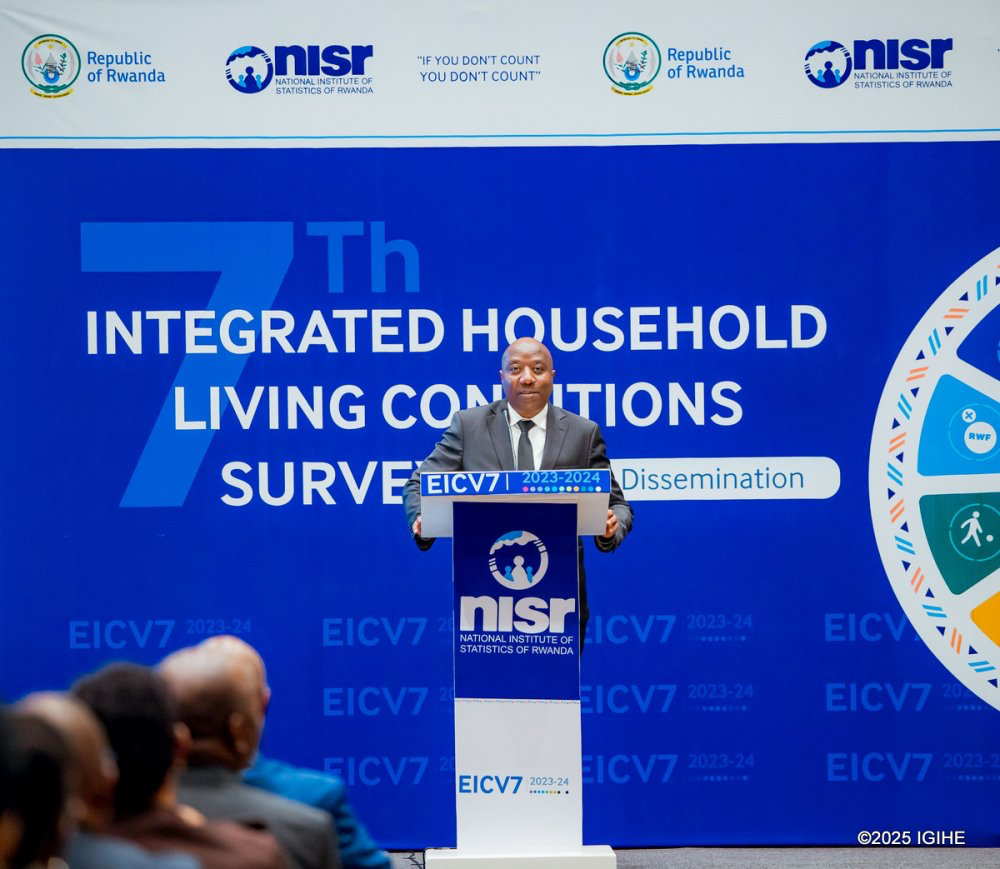
The Seventh Integrated Household Living Conditions Survey (EICV7) has revealed a significant decline in poverty among Rwandans over the past seven years, attributed to the creation of numerous jobs that have increased individual incomes.
The EICV7 survey was conducted over a 12-month period in 2024 and covered 15,066 households.
Findings indicate that poverty in Rwanda dropped from 39.8% in 2017 to 27.4% in 2024, while extreme poverty decreased from 11.3% in 2017 to 5.4% in 2024.
According to the National Institute of Statistics of Rwanda (NISR), for a Rwandan to afford food and other basic necessities, they need at least 560,027 Rwandan Francs annually.
Current data shows that the average annual income per Rwandan is $1,040. Between 2017 and 2024, 1,374,214 jobs were created, surpassing the national goal of 250,000 jobs per year.
The EICV7 survey also revealed that 1.5 million households escaped poverty over the seven-year period, translating to a 12.4% reduction in poverty.
Yvan Murenzi, Director General of NISR, said that poverty reduction was driven by improved living conditions and government programs.
“We worked with LODA to analyze households under the Vision 2020 Umurenge Program (VUP). Among these, the poverty rate stands at 40.5%. It is likely that poverty initially affected around 70% of these households, meaning the program had a tangible impact,” he stated.
However, Murenzi emphasized the need to strengthen agriculture to stabilize market prices.
Data also shows that in 2024, 59% of households received remittances from abroad, up from 23% in 2017. Among them, 36% were rural households, receiving a total of 198 million Rwandan Francs in one year.
Finance and Economic Planning Minister Yussuf Murangwa noted that the survey results will guide government investment decisions aimed at boosting citizens’ economic wellbeing.
“We have seen a significant drop in both poverty and extreme poverty. Access to infrastructure like water and electricity has also improved, especially in rural areas and among the most vulnerable. […] In reality, we should not still have extreme poverty in this country,” he said.
Urban poverty currently stands at 16.7%, while in rural areas it’s at 31.6%. Extreme poverty in urban areas is 3.1%, compared to 6.4% in rural areas.
The 10 districts with the highest poverty rates are Nyamagabe, Gisagara, Rusizi, Nyanza, Nyamasheke, Rutsiro, Nyaruguru, Kamonyi, Rubavu, and Karongi.



Leave a Reply