
Leaked intelligence details alleged Sudan army chemical weapons programme
By Staff Reporter.
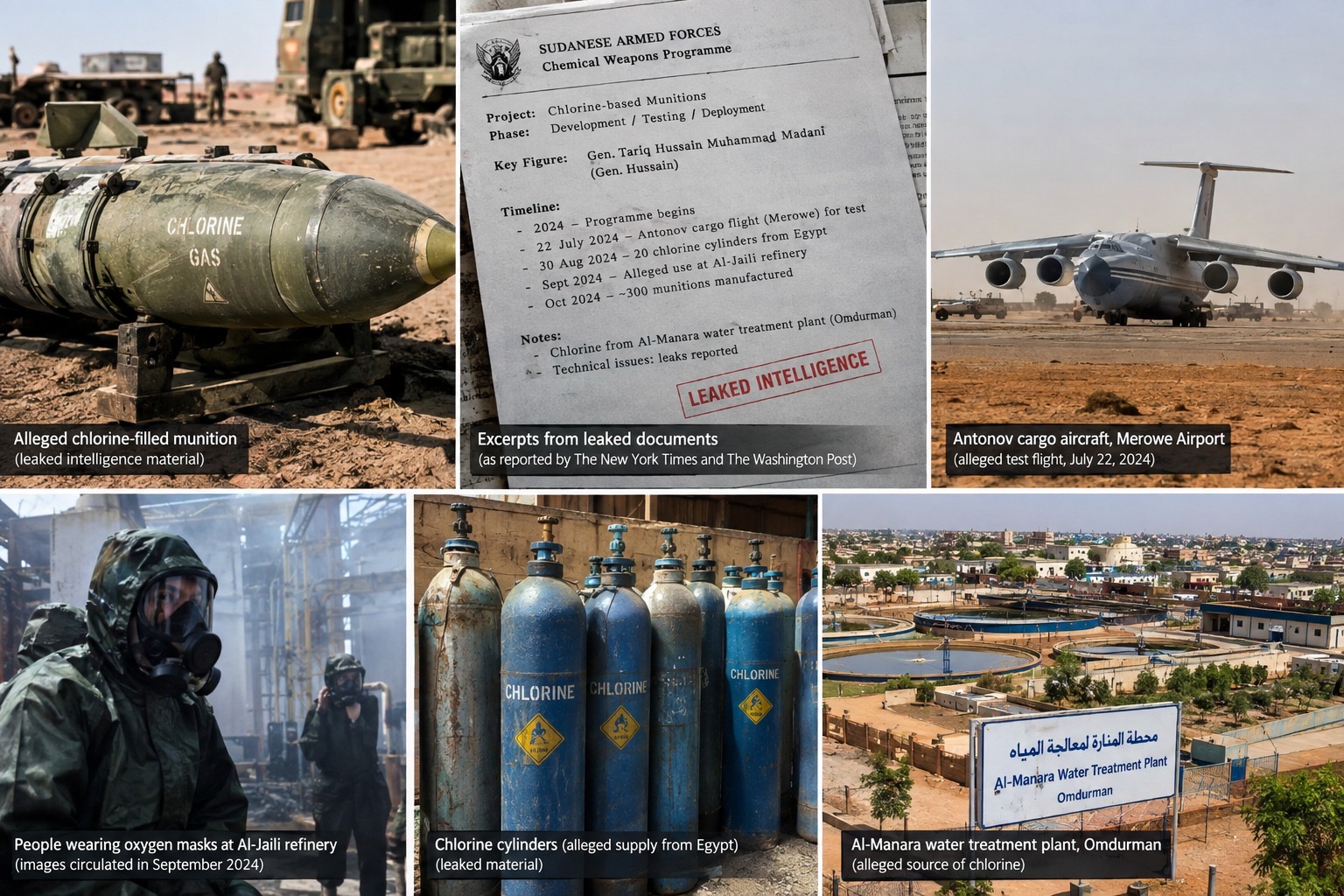
Newly leaked intelligence files have provided fresh and detailed evidence of an alleged chemical weapons programme operated by Sudan’s Armed Forces (SAF), including the development, testing and possible deployment of chlorine-based munitions against the Rapid Support Forces (RSF).
Investigations published by The New York Times and The Washington Post on September 5 drew on leaked documents, photographs, videos, intercepted communications and text messages attributed to Sudanese military officials.
The New York Times reported that its dossier contained nearly 150 documents, images, videos and voice recordings, alongside thousands of text messages, much of them apparently extracted from the phones of senior Sudanese officers. The Washington Post separately reported that the material it reviewed provided credible evidence of a chemical weapons programme, while stressing that definitive confirmation would require independent access to suspected weapons sites and witnesses.
The material points to an alleged programme that began in 2024 and involved the manufacture and testing of chlorine-filled munitions. It also raises questions about whether chlorine intended for civilian water treatment was diverted for military purposes.
Sudan has consistently denied developing or using chemical weapons. The country’s military authorities have maintained that Sudan complies with the Chemical Weapons Convention.
Alleged programme emerged during Khartoum fighting
According to the New York Times investigation, the SAF began developing chlorine weapons as it sought to break a battlefield stalemate in Khartoum in 2024.
The leaked records identify General Tariq Hussain Muhammad Madani, referred to in the reports as General Hussain, as a central figure in the alleged programme. U.S. Treasury records separately identify him as a senior SAF procurement official and managing director of Target Multiactivities Company Ltd.
Messages attributed to Hussain describe plans for a weapon combining an explosive warhead with chlorine gas. The proposed munition was designed to cause casualties through both fragmentation and exposure to chlorine.
On July 22, 2024, an Antonov cargo aircraft reportedly took off from Merowe Airport for a weapons test. Hussain later described the test as successful and said the munition had struck its target and released gas, according to the leaked communications. Brigadier General Amir Idris, identified in the records as a supervisor of military drone operations, responded by ordering strict secrecy.
The programme reportedly experienced technical problems, including chlorine leaks. One message described workers finding dead insects and scorpions inside a hangar after exposure to leaking gas.
Questions over chlorine supplies
The leaked material also describes efforts to secure chlorine for the alleged weapons programme.
In late August 2024, Hussain reportedly said 20 chlorine cylinders had been brought from Egypt and estimated that the supply could produce about 1,100 munitions.
He also allegedly said that chlorine had been obtained from the Al-Manara water treatment plant in Omdurman.
The allegation is significant because chlorine is widely used to disinfect drinking water and help control cholera outbreaks. The New York Times reported that the International Committee of the Red Cross had donated 30 chlorine cylinders to the plant in 2023, while CARE reported supplying 35 cylinders between 2024 and 2025. UNICEF also said it had supplied chlorine to six water-treatment plants in Khartoum, including Al-Manara, between 2023 and 2025.
However, there is no evidence establishing that chlorine supplied by any particular humanitarian organisation was diverted into the alleged weapons programme. UNICEF said it had no record of UNICEF-supplied chlorine being diverted or misused.
By October 2024, Hussain reportedly said that almost 300 chemical munitions had been manufactured, with most stored at Merowe.
Alleged use against RSF
The leaked material also contains claims that chlorine weapons were used against RSF positions.
In September 2024, Hussain reportedly sent a message saying, “They drank the gas,” in reference to an attack at the Al-Jaili oil refinery north of Khartoum, then controlled by the RSF.
The claim corresponds with accusations made by the RSF on September 13, 2024, when the group accused the Sudanese army of using toxic weapons at the refinery. Images circulated at the time showed people inside the facility wearing oxygen masks.
Earlier investigations had also examined evidence of chlorine being used at Al-Jaili. The Washington Post reported that U.S. authorities had previously accused Sudan of carrying out chlorine gas attacks on RSF positions at Al-Jaili and Garri Military Base in 2024.
However, experts caution that establishing precisely which weapons were used in particular attacks requires independent examination of physical evidence.
Alleged cover-up
The leaked records also point to efforts to conceal the programme after the United States became aware of it.
According to the material reviewed by the New York Times and Washington Post, messages attributed to senior Sudanese military officials refer to removing traces and residue from locations associated with the alleged programme.
The documents also indicate that Sudan later established a committee to investigate U.S. allegations that its military had used chemical weapons. The New York Times reported that Hussain, identified in the leaked material as a key figure in the alleged programme, was included in the investigation process.
Sudan’s own investigation reportedly concluded that it found no evidence of chemical or radioactive contamination.
U.S. and international pressure
The allegations have been at the centre of growing international pressure on Sudan.
In May 2025, the United States determined that Sudan had used chemical weapons in violation of international law and imposed measures against the country. The U.S. has since pressed Sudan to declare any chemical weapons production facilities and munitions and to cooperate with the Organisation for the Prohibition of Chemical Weapons (OPCW).
The United States also sanctioned Burhan in January 2025, but the Treasury’s announcement at the time based the designation on his leadership of the SAF and the conduct of the military during the conflict. The announcement did not identify chemical weapons as the specific legal basis for the sanction.
The OPCW has continued to monitor allegations concerning chemical weapons in Sudan. In 2025, its director-general said the organisation was monitoring the allegations but had not received a sufficiently substantiated request for additional activity.
In March 2026, the United States told the OPCW that it had determined that chemical weapons were used in Sudan in 2024 and urged Sudan to declare any chemical weapons facilities and munitions and cooperate with international verification.
The newly published leaked material adds significant detail to those earlier allegations, but independent verification of the full programme and individual attacks remains difficult because investigators have not had unrestricted access to suspected sites and witnesses.
The disclosures are therefore likely to intensify calls for an independent international investigation into whether chemical weapons were developed, stockpiled and used during Sudan’s ongoing conflict.


Leave a Reply