
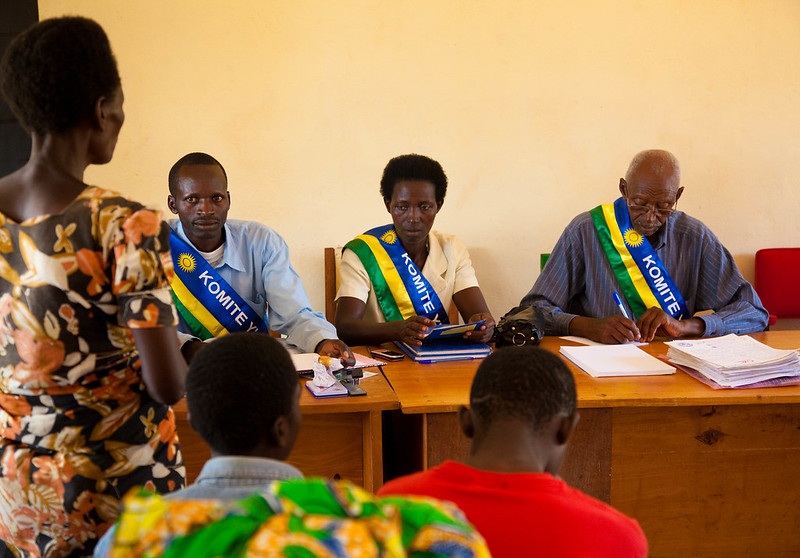
Law allows Abunzi (mediators) to continue civil cases mediation beyond term as a result of ‘force majeure’
By The Inspirer
Mediators, locally known as ‘Abunzi’, will continue mediating disputes when their term has ended if there is force majeure – unexpected circumstances that are beyond control, such as Covid-19 pandemic – which hinders the election of new mediators.
This provision is contained in the law of law determining organisation, jurisdiction, competence and functioning of an Abunzi committee, and it is the only amendment made to the law of 2016 on the same.
A plenary sitting which comprised 67 Members of Parliament unanimously voted the law on Friday, October 23, 2020, without having to first be sent to the responsible committee for scrutiny. The Chamber of Deputies of Rwanda has 80 members, but others were carrying out different parliamentary duties.
As she was explaining the relevance of the bill, Soline Nyirahabimana, Minister of State in charge of Constitutional and Legal Affairs at the Ministry of Justice requested that it immediately gets voted into law as it was urgent.
At the Cell and Sector levels, the Abunzi Committee is comprised of seven persons of integrity who must all be residents of the Cell and the Sector respectively and well-known for their conciliation skills.
Members of Abunzi Committee are elected for a renewable term of five (5) years.
The recent Abunzi Committee members were elected in 2015 and their tenure ended on July 31, 2020.
Before their term ended, the Ministry of Justice in partnership with the National Electoral Commission organised election for the new Committee, but was impeded by the Covid-19 pandemic as the preventive measures against the spread of the disease.
In order to prevent a situation where citizens lack where to file their cases, the Ministry of Justice issued a statement on July 31 indicating that the cases that previously lodged to mediation committees will be submitted to local leaders – cell and sector executive secretaries – in the respective jurisdictions, pending the election of the new ones.
Nyirahabimana said that the Ministry decided to extend period to provide mediation service for the mediators who completed their term because it was not known when the pandemic will be completed subdued.
“It is in that framework that a bill amending the law of 2016 was proposed,” she said.
“The law seeks to remove hindrances that stop Abunzi to carry on their activities in case there are circumstances that inhibit election to replace them until they are overcome and the new ones are voted,” she said.
Also, the Minister said that the law will have retroactivity so that it the new change starts being applied from August 1, 2020 in order to resume mediation work from where they were the recent term ended.
Lawmakers’ worries
Some lawmakers argued that the law should stipulate how long such mediators will serve after their tenure has ended, and how that should be done.
However, Minister of State, Nyirahabimana said that the circumstances for which such a provision is applicable are not predictable, hence it is not possible to know how long they could last.
“We will exercise caution to ensure that such a move is done accordingly, and it is not abused,” she said while responding to lawmakers’ concerns.
“What we want is that people do not lack justice because of situations such as Covid-19 pandemic,” she said.
MP Odette Uwamariya wondered whether local leaders – cell and sector executive secretaries – who only have the legal powers of non-professional bailiffs received people’s complaints and solved them.
“If they solved the civil cases, what legal status do they have,” she wondered.
However, Nyirahabimana said that the local leaders only received the complaints, but did not handle them.
Mediation of more than 2,600 cases put on hold
Since August 1, and October 22, 2020, Nyirahabimana said, residents submitted a total of 2656 cases, including 2099 at the cell level, and 557 at the sector level.
“We will make a follow-up to ensure that such files are smoothly accessed by the mediators so that they solve them,” she said adding that there will be a collaboration between concerned institutions including the Ministry of Local Government and the Ministry of Justice.
The Abunzi Committee has the jurisdictional powers to preside over civil matters whose value does not exceed Rwf3 million Rwandan francs.
Before the Law of 2016 above mentioned, Abunzi Committees had jurisdiction over minor criminal cases.
Abunzi committees were introduced in 2004. There were more than 18,000 mediators across the country as of 2019.
Statistics from the Ministry of Justice show that Abunzi solved 97.8 percent of the over 48,000 complaints that they received in the 2018-19 financial year, a slight improvement compared to 97.3 percent in the previous year.





Leave a Reply