

Tonnes of ‘expired laboratory chemicals’ in Rwandan schools require proper disposal
By Michel Nkurunziza.
Tonnes of ‘used and expired laboratory chemicals’ in secondary schools and higher learning institutions are in need of proper disposal and management.

Expired Lab chemicals at a secondary school in Huye district.
Expired laboratory chemicals and products are one of the issues observed in science teaching schools that have laboratories.
Though they help students in acquiring hands-on knowledge in sciences, they pose health risks if not properly handled – especially expired ones, according to Abias Maniragaba, an expert in environmental health.
“The environmental effects of expired chemical products include water pollution and soil contamination, particularly when these chemicals are not properly disposed of. Air quality can also be compromised, and wildlife along with entire ecosystems may suffer as a result.

Expired Lab chemicals at University of Rwanda
Chemicals containing mercury, which have been in use for a long time, pose serious health risks—prolonged exposure can damage the nervous system, lead to developmental issues in children, and even result in death,” he said.
Other substances, he said, such as lead used in chemical reactions, are equally harmful.
In children, lead exposure can cause developmental delays, learning disabilities, and behavioral problems, while in adults, it may lead to high blood pressure, kidney damage, and reproductive health issues, he added.
Sr. Philomène Nyirahuku, the head of Ecole Notre Dame de la Providence – Karubanda in Huye District said:“NESA last year coordinated transportation of used and expired laboratory chemicals for disposal. But this is not currently being done regularly. We have to wait for long. As a sustainable solution, we need our own incinerator at the school. A study is needed so that we get our own incinerator.”

The expired lab chemicals have no safe disposal in schools in Rwanda.REMA
She explained that since last year the school is waiting for collection of the used and expired chemicals.
“We still have other used and expired lab chemicals to handle. They are still stored in our schools and not sure if they are safe,” she noted.
The school had 236 kilogrammes of expired chemicals and contaminated materials requiring management, as per assessment by Rwanda Environment Management Authority (REMA) in 2024.
Groupe Scolaire Officiel de Butare (GSOB) Indatwa n’inkesha in the same district had 485.76 kilogrammes of expired chemicals and contaminated materials while Petit Seminaire ‘Virgo Fidelis’ De Butare had 494.2 kilogrammes of expired chemicals and contaminated materials in need of proper disposal.
Ecole des Sciences Byimana in Ruhango District had 245.5 kilogrammes of expired chemicals to be handled while MARIST BROTHERS had 211.51 kilogrammes of expired chemicals and contaminated materials in need of management.

Students conducting experiment using lab chemicals. Michel Nkurunziza
“We were requested to collect such expired chemicals so that they be transported for disposal as we do not have a safe way of disposing of them. We dump very few of them. Experts trained some teachers and lab technicians,” Jean Marie Vianney Ingabire, Headteacher at Ecole des Sciences Byimana said.
While some teachers and lab technicians were trained to gain waste disposal skills, others have not yet been trained.
“We usually have such expired lab chemicals. Some were recently collected and transported since we have no proper disposal. We have no safe places for disposal and we avoid dumping them into holes. We store them until a company sent by NESA transports them. Meanwhile this is the third year as lab technician but have not yet received training on proper handling and guidelines,” said Flodouard Ntawukuriryayo, a lab technician at GS Rwebare in Nyagatare District.
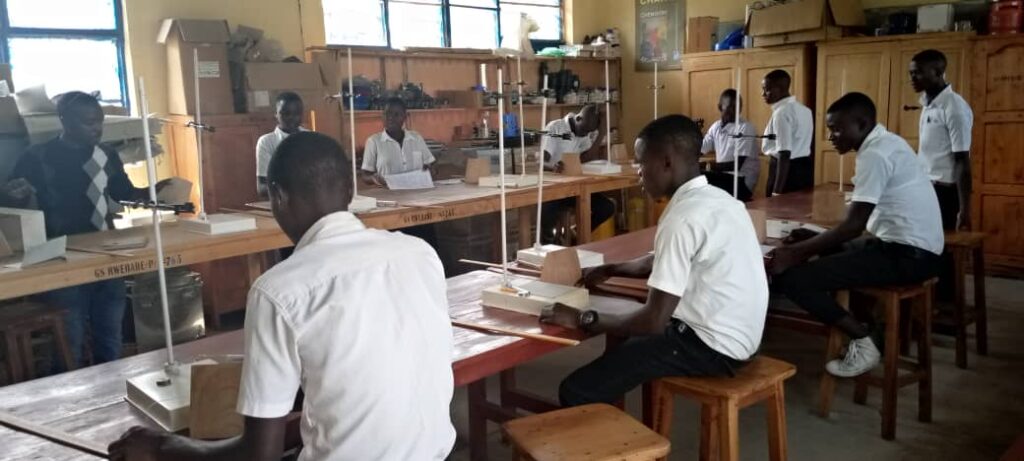
Lab chemicals used by students in science schools pose threat to environment.Michel Nkurunziza
In the same district, Nyagatare Secondary School, for instance, had 91.84 kilogrammes of expired chemicals and contaminated materials according to an assessment.
In Kayonza District, ES Kayonza Modern had 2,062 kilogrammes of expired chemicals and contaminated materials.
In Burera District, E.S Kagogo had 476.18 kilogrammes of expired chemicals and contaminated materials.
In Gakenke District, G.S ST JEROME JANJA had 396.352 kilogrammes.
In Karongi District, an assessment showed that College Saint Marie Kibuye had 630.6 kilogrammes in need of handling while G.S Gihundwe in Rusizi District had 317.22 kilogrammes as E.S Nyamugari had 447.376 kilogrammes.
In Kicukiro District, KAGARAMA Secondary School had 406.42 kilogrammes of expired chemicals and contaminated materials to be handled while G.S Karembure had 468 kilogrammes.
In Nyarugenge District, COLLEGE SAINT-ANDRE had 282 kilogrammes of expired chemicals and contaminated materials.
27 tonnes of expired chemicals required handling
According to the survey by REMA, schools are sources of chemical wastes mostly from the laboratories.
Data from 197 secondary schools show there is a total of 26,981,461 kilogrammes (nearly 27 tonnes) which need to be disposed of.
The visited schools don’t have proper storage for expired chemicals.
Some contained mercury used for experiments.
The common issues in schools are the lack of a plan and budget to dispose of the expired chemicals and the lack of staff with waste management skills as well as the lack of a safe place for the disposal of such waste.
Most of the schools keep those wastes on shelves with chemicals.
As the quantity of the chemical increases, some schools dump them or throw them in septic tanks, REMA warned.
Chemical waste generated in higher learning institutions in Rwanda and research institutions was also estimated at 15.1 tonnes.
Apart from the damaged and used chemicals, there is a challenge in planning leading to the accumulation of expired chemicals.
For example, the centres for national exams receive many chemicals to use in the practice of those exams.
After the exams, the remaining chemicals stay at those schools and sometimes they are not needed by those schools.
Also, there are some schools receiving chemicals from REB and most of the time they receive the ones they do not need.
“This leads to the accumulation and expiration of chemicals in those schools. Many of the visited schools expressed their concern about the management of the chemical wastes,” REMA said.
“Referring to the questionnaire results, the leaders of schools or laboratory technicians wish the presence of disposal places for chemical wastes at least in every district so that every time they have chemical wastes, they can bring them there.”
During the survey, the survey found that there are schools disposing of chemical wastes in cemented pits and others having agreements with hospitals having incinerators for the destruction of those chemical wastes.
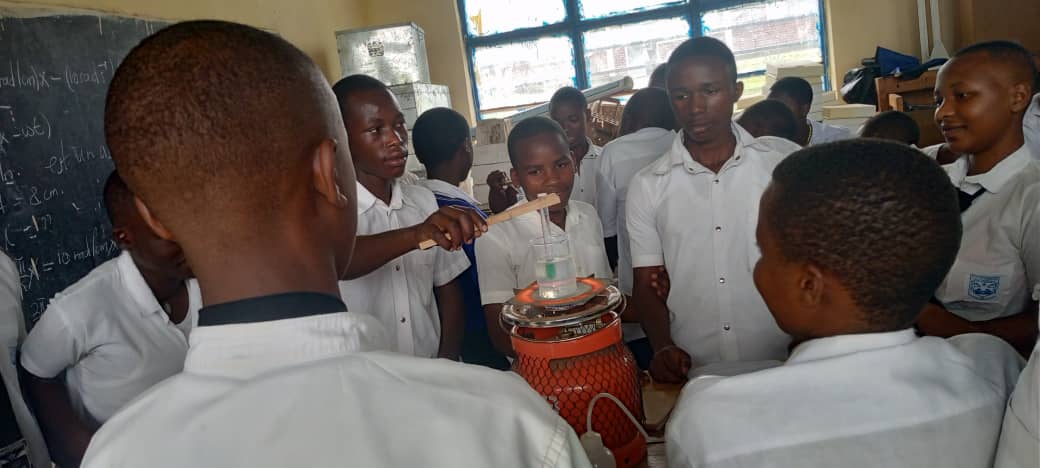
Lab chemicals should be well disposed of and incinerate after use.Michel Nkurunziza
There is no plan and no budget for the secondary school to dispose of expired chemicals in a proper manner.
Secondary schools in Rwanda don’t have skilled lab technicians.
Some schools have/get chemicals even if there is no chemistry laboratory and these chemicals end up being expired.
This was observed at GS St Vincent Pallotti/Gikondo.
Most of these expired chemicals have been staying in their stock for a long time, some from 2015 to date.
REMA’s recommendations
REMA recommended preparing a collection site at each district in Rwanda for chemical waste temporary storage while waiting for disposal.
“There is a need to revise the existing procedure of how these secondary schools obtain the chemicals. We recommend the policy maker, especially REB, to put in place a channel where each school can report on time the quantity of expired chemicals, we propose quarterly reporting.”
Each school should have an action plan, regarding the requisition and usage of chemicals depending on the number of programmes and students.

The visited schools don’t have proper storage for expired chemicals.Michel Nkurunziza
It was recommended for each secondary school to have a proper wastewater treatment mechanism to treat liquid waste contaminated with hazardous chemicals before they can be released into the environment.
On the side of higher learning institutions, to solve that problem, they have agreements with institutions or companies which incinerate those wastes.
For example, Depot Karisimbi took the chemical wastes from UR-CST for incineration while the UR-CAVM/Busogo and INES Ruhengeri send the chemical wastes to Ruhengeri Hospital for incineration.
What is being done
Faustin Munyazikwiye, the Deputy Director General of Rwanda Environment Management Authority (REMA), said that under the “Supporting a Green Economy – Decoupling Hazardous Waste Generation from Economic Growth” project, led by REMA, a licensed partner, Depot Kalisimbi Ltd, has been contracted by REMA and is now responsible for collecting and incinerating expired chemicals from schools.
“Collections have covered the Southern Province, City of Kigali, and are expanding to the Eastern, Northern, and Western Provinces,” he said.
From the Southern Province and City of Kigali, he noted, collection was done in 230 secondary schools and TTCs and 8 higher learning institutions where a total of 46,094.99 kilogrammes of chemicals were collected and treated in the Mageragere industrial incinerator.
“In partnership with the Rwanda Education Board (REB), schools must justify chemical use and are only provided with necessary quantities. This reduces waste and promotes responsible chemical management,” he said.
A national interim storage facility for hazardous waste is being developed, ensuring safe storage until final disposal.
Over 2,880 individuals, including science teachers and laboratory technicians, have been trained in hazardous waste management, Munyazikwiye said.
“Ongoing training ensures that new staff receive the necessary skills, with refresher courses to maintain best practices. REMA is planning for a long-term partnership with REB where these trainings will continue, ensuring long-term sustainability.”
He added that awareness campaigns to promote a culture of safe chemical use and waste management among students and staff are being conducted.
Abias Maniragaba, an expert in environmental health, said safe storage of all expired chemicals in a ventilated area away from students is needed.
“Not dispose the expired product in the sinks or toilets. Separate incompatible chemical to prevent further reaction, Contact licensed hazardous waste disposal companies. Train teachers and laboratory staff on chemical safety, including handling, storage, and emergency procedures, just to name few,” he advised.
This story was produced with the support of Rwanda Environmental Journalists (REJ) and Fojo Media Institute.


Leave a Reply