
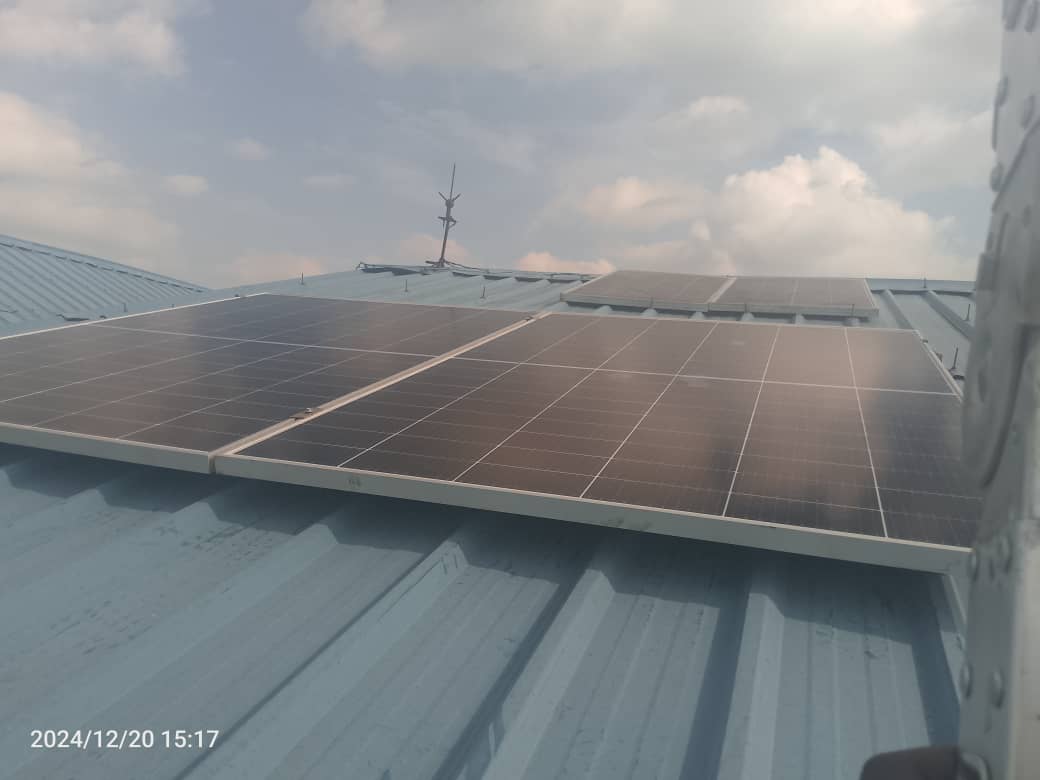
The power of solar power for Rwandan schools without electricity in remote areas
By Michel Nkurunziza.
Cyamburara Primary School, nestled in the remote Buhabwa Village, had been without electricity since its founding in 2003.
Until last December, the school’s lack of power severely hampered teaching and learning.
However, the recent installation of solar energy has begun to transform the educational landscape.
Prior to the solar installation, teachers faced arduous journeys, traveling approximately 35 kilometers to print exam papers and essential documents.
“Every week, students take tests, and we had to make these long trips for printing,” explained Ladislas Marora, the school’s headteacher.
The cost, over 3,000 Rwandan francs (approximately $2.30) for a motorcycle ride to the nearest cybercafé in Karubamba Centre, Rukara Sector, further strained the school’s meager resources.

The school was connected to solar power to enable its operations.
The absence of electricity also precluded the establishment of a computer lab, hindering the integration of information and communication technology (ICT) into the curriculum.
Government initiatives like the “laptop-per-child” program and teacher laptop distribution were delayed.
“Pupils were learning about computers from pictures, having never touched one,” Marora said.
The inability to access online national exam results further compounded the school’s isolation.
“We don’t know how to use computers, and we haven’t seen any in our school. We only know about them in theory, learning through the Science and Elementary Technology book. In the coming years, we might face difficulties when competing with those who are already computer literate and familiar with such tools,” said Odile Abanabayo, a P5 pupil.
Innocent Ntaganda, the Director of Education in Kayonza District, confirmed that the installation of solar power at Cyamburara Primary School would pave the way for a computer lab. The benefits extend beyond the school gates.
“Our family was spending 1,200 Rwandan francs weekly on phone charging in distant urban centers. With solar power at the school, we’re saving both money and time,” said Claudette Nyirabaributsa, a local resident.
The challenges faced by Cyamburara Primary School are not isolated. Emmanuel Nzasingizuhoraho, a teacher at GS Ruhanga in Gakenke District, Northern Province, highlighted the disparities in technology adoption across rural schools.

The school no longer prints exam papers in cybercafes after getting solar powered system.
“Our school, though recently equipped with solar panels, lacks a computer lab and consistent internet access, impacting teaching quality and student retention,” he said.
The school has been able to purchase a printing and photocopy machine and utilize the Rwandan Education Board’s e-learning platform.
“We can download books, songs, and plays, enriching our teaching,” Nzasingizuhoraho added.
Augustin Uwiringiyimana, a teacher at GS Mugega in Ngororero District, Western Province, echoed these concerns.
“Computers arrived late because of the lack of electricity. Improving infrastructure is crucial for educational quality,” he said.
Community demands expansion of solar initiative
Parents and students are now advocating for the expansion of solar power from schools to homes.
“If we had electricity or solar power, our children could study at night, improving their performance,” said Felicien Nkundakozera, a resident of Muyira Sector, Nyanza District.
Anne Marie Twagiramana, a beneficiary of solar power kits in Nyanza District, expressed gratitude for the support, anticipating improved academic outcomes for her children.
Patrick Kajyambere, the Vice Mayor in Charge of Economic Development in Nyanza District, reported that electricity access in the district was at 77 percent, with Muyira Sector lagging at 66 percent.
The scale of the challenge
According to the Rwanda Education Statistical Yearbook, approximately 20 percent of Rwandan schools lack electricity access.
This translates to roughly 1,000 schools across the country struggling without power.
Albert Nsanzimana, the head of Ntobwe Primary School in Huye District, Southern Province, estimated that his school spends nearly 1 million Rwandan francs annually on transportation and printing.
“This cost could be redirected to school feeding if we had solar power,” he said.
“Without electricity, schools in remote areas lack access to digital learning resources, hindering their technological advancement,” Nsanzimana explained. “We need grid electricity or solar power. With internet, teachers can utilize ICT tools and conduct research. Smartphones, too, could be valuable, but we lack charging facilities.”
Joseph Nsengiyumva, Rwanda’s Minister of Education, acknowledged the ongoing challenges.
“We have identified 551 schools without electricity and are exploring solutions, including solar power,” he said.
According to Ministry of Education data, 3,057 primary schools and 1,718 secondary schools use grid electricity, while 1,012 schools rely on solar power.

Installation of solar power systems are enabling installation of internet
Rwanda aims to achieve 95 percent electricity access in schools by 2029, up from the current 80.7 percent.
The government’s education sector strategic plan (2024-2029) emphasizes the role of ICT in education, aiming to increase the percentage of schools using ICT in teaching and learning from 41.1 percent to 65 percent.
Stéphanie Mukangango, an education expert and member of Syndicat National des Enseignants au Rwanda (SNER), underscored the importance of electricity in education.
“I believe everyone is aware of the importance of electricity. It is essential for the study of subjects like ICT and computer use, as well as various demonstrations using computers,” she said.
A study published in Joule, a monthly journal that publishes research on energy highlighted the challenges faced by Sub-Saharan African schools, with approximately 32 percent of primary schools and nearly half of secondary schools lacking electricity.
Octave Idrissa, Operations Director at Ignite Power Rwanda, advocated for the integration of internet connectivity with solar power installations.

One school got Internet after solar power installation
“We are deploying solar systems and Starlink internet in government-aided schools. The government should subsidize the cost for all schools that want to buy the systems,” he said, noting that they have powered 30 schools with a target of 241.
The Government of Rwanda has forged a transformative partnership with Ignite Power, a leading provider of global solar-based solutions and the recent winner of the prestigious 2023 Zayed Award, to connect schools in the country to the internet and solar power.
Rwanda’s new energy policy, released in February 2025, aims to enhance solar energy use, with plans for 30 megawatts of solar power by 2029-2030 and an additional 20 megawatts by 2034-35.
Innocent Hakizimana, an electrical engineer, highlighted the solar potential of the Eastern and Southern Provinces.
“We need long-storage solar systems for remote schools in the Western and Northern regions,” he said.
As of 2025, Rwanda’s total electricity generation capacity is 556 MW, with hydropower accounting for 50 percent, methane gas for 30 percent, peat for 14 percent, and solar energy for 4 percent, according to Rwanda Energy Group (REG) data.
Hakizimana also suggested that Rwanda signing the Fossil Fuel Non-Proliferation Treaty would encourage private sector investment in renewable energy.


Leave a Reply