
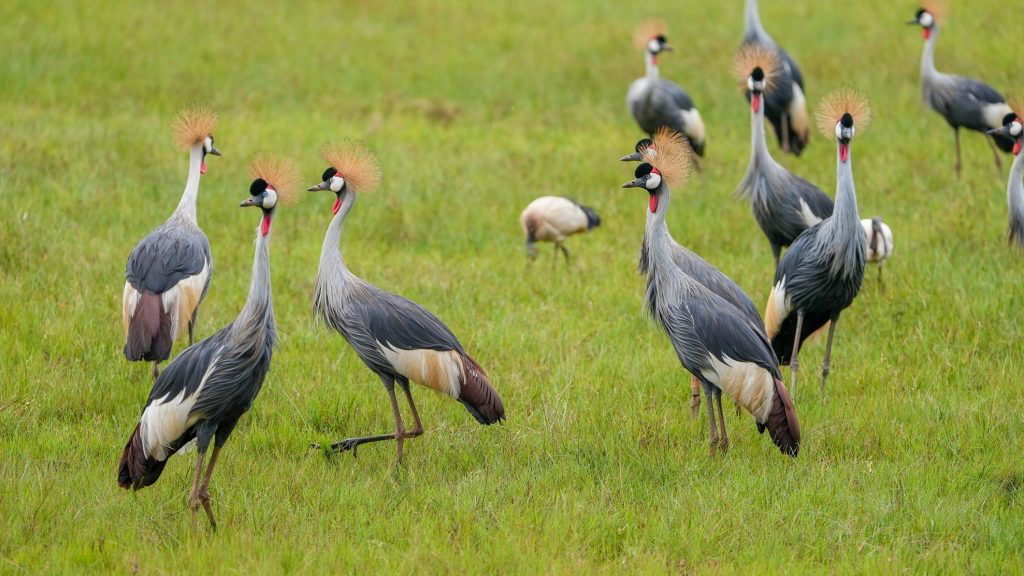
Rwanda recognised for efforts to restore Grey Crowned Crane population
Rwanda has received the Africa Biodiversity Award in recognition of its efforts to protect the Grey Crowned Crane, an endangered bird species whose population has been declining across Africa.
The award was presented to the Rwanda Wildlife Conservation Association (RWCA), a non-governmental organisation working to protect wildlife, in recognition of its significant contribution to conserving one of Africa’s threatened bird species.
The Fondation Biodiversity Award (FBVA) said RWCA had adopted an innovative, integrated approach to biodiversity conservation, combining wildlife rescue, law enforcement and community engagement, particularly involving people living near protected areas and other natural habitats.
According to the foundation, RWCA’s conservation initiatives have helped end the illegal hunting and capture of Grey Crowned Cranes. Instead, the birds are now being protected, leading to a significant increase in their wild population from fewer than 300 to more than 1,200.
Former poachers become conservation champions
Rwanda was also recognised for transforming local communities, including former poachers, into active participants and leaders in wildlife conservation.
The initiative has provided an example of a sustainable conservation model that could be replicated elsewhere and is now being expanded to other East African countries.
A decade ago, the Grey Crowned Crane, regarded as one of Rwanda’s iconic bird species, was on the brink of extinction in the wild, with fewer than 300 remaining in the country.
Olivier Nsengimana, a Rwandan conservationist who grew up in the countryside admiring the birds, became aware of the severity of the problem after studying veterinary medicine.
“I was particularly troubled by the fact that Grey Crowned Cranes were more common in people’s gardens and hotels than in the wetlands where they naturally belong. Their wings were often clipped to prevent them from flying away, while many were poorly fed and kept in unsuitable conditions that prevented them from breeding,” he said.
In 2015, he launched a special initiative in partnership with the Rwandan Government. His team engaged people who kept the birds in their homes and discovered that many genuinely loved them.
In local culture, the cranes were traditionally regarded as symbols of wealth, beauty and longevity, and people took pride in keeping them in their gardens.
“Instead of immediately taking legal action against them, we gave them an opportunity to voluntarily surrender the birds and become part of a national conservation programme. The response was overwhelming,” he said.
When collecting the birds from people’s homes, the team examined them, fitted them with identification rings and provided veterinary treatment.
After being quarantined and cared for until they recovered, birds capable of returning to the wild were released into Akagera National Park under a specially designed programme.
In 2018, Nsengimana formally established the Rwanda Wildlife Conservation Association (RWCA).
The practice of trapping cranes for sale, which some community members had previously engaged in due to limited knowledge about their conservation, has since been brought to an end.
The organisation’s latest census shows that the wild population has increased to more than 1,200 birds.
Nsengimana said RWCA had also established a network of trained community members known as Community Conservation Champions. They monitor bird populations and other wildlife using scientific methods that incorporate data collected by local residents.
The champions also help protect Rugezi Wetland and provide information that guides RWCA’s conservation decisions.
Rugezi Wetland is recognised as a wetland of international importance under the 1971 Ramsar Convention.
More than 130,000 indigenous trees have also been planted, with a survival rate of 95%, largely due to continued community participation.
Meanwhile, the international FBVA Foundation Worldwide Award went to Indonesia’s Alam Sehat Lestari (ASRI) organisation for its work restoring tropical rainforests and peatlands on the island of Borneo.
The organisation has planted indigenous trees, helping reduce forest degradation by 70%, while protecting Bornean orangutans and the Sunda pangolin.
Other award categories recognised biodiversity conservation in Spain, environmental education and communication in Spain and internationally, as well as the Biophilia Award for work exploring human knowledge and relationships between people and the environment.
Scientific research has also contributed to the recovery of seabirds in the Gulf of Mexico, which is home to approximately one-third of the world’s seabird species. Its islands provide critical habitats where the birds can find shelter and breeding grounds.





Leave a Reply