
Rwanda’s national exam results show sharp rise in performance, but also expose pressure points in education system
By Elias Hakizimana.
Rwanda’s latest national examination results have revealed a significant improvement in student performance, with pass rates rising sharply at both primary and Ordinary Level even as the number of candidates increased substantially.
The results for the 2025/26 academic year, released on August 20, 2026, cover the Primary Leaving Examination (PLE) and Ordinary Level (O-Level) national examinations held in July.
At O-Level, 85.70% of the 149,015 candidates who sat the examinations passed, a major increase from 64.35% recorded in the previous academic year. At primary level, 88.21% of 276,579 candidates who sat the PLE passed, compared with 75.64% the previous year.
The improvement is particularly striking at O-Level, where the national pass rate increased by more than 21 percentage points in a single year.
The results also came despite a substantial increase in the number of learners sitting the examinations, presenting a more complicated picture than the headline improvement alone suggests.
Record performance at the top
At the individual level, several students posted exceptionally high scores.
In the O-Level examinations, Leontine Uwamariya of ISF Nyamasheke and Musonga Isimbi Olla of FAWE Girls School in Gasabo shared the top position after both scoring 98.7%.
They were followed by Joel Ganza of Saint Ignatius High School in Gasabo, who scored 98.6%, while Milton Uwitonze Kefa of College Saint André in Nyarugenge scored 98.4%.
Richard Kwizera Mukwiye and Divine Uwase of Ecole des Sciences Byimana in Ruhango each scored 98.3%.
At primary level, Bruno Ricky Rwego Mutijima of Ecole Internationale La Racine in Bugesera emerged as the top performer with 99.6%. Seven other candidates followed with 99.4%.
The results put schools from several parts of the country among the strongest performers, showing that academic excellence is not confined to Kigali.
Kirehe leads districts
At district level, Kirehe emerged as Rwanda’s strongest-performing district for the second consecutive year.
More than 99% of candidates in the district passed the PLE, while its O-Level pass rate reached 99.98%.
Musanze ranked second in O-Level with a 96.63% pass rate, followed by Karongi at 94.77%. In the PLE, Ngoma ranked second at 95.27%, followed by Musanze at 93.9%.
The district-level differences nevertheless show that national improvement does not mean that all parts of the country are progressing at the same pace.
At O-Level, Nyarugenge recorded the lowest pass rate at 71.41%, followed by Gasabo at 74.63% and Gakenke at 76.37%.
At PLE level, Nyamagabe recorded 81.45%, Gisagara 81.72% and Gasabo 82.23%.
These disparities raise a broader question for policymakers: how can the improvements seen nationally be translated into more consistent learning outcomes across districts?
The Uwamariya episode
Against this backdrop of celebration, the case of Uwamariya added an unexpected human-interest and accountability dimension to the release of the results.
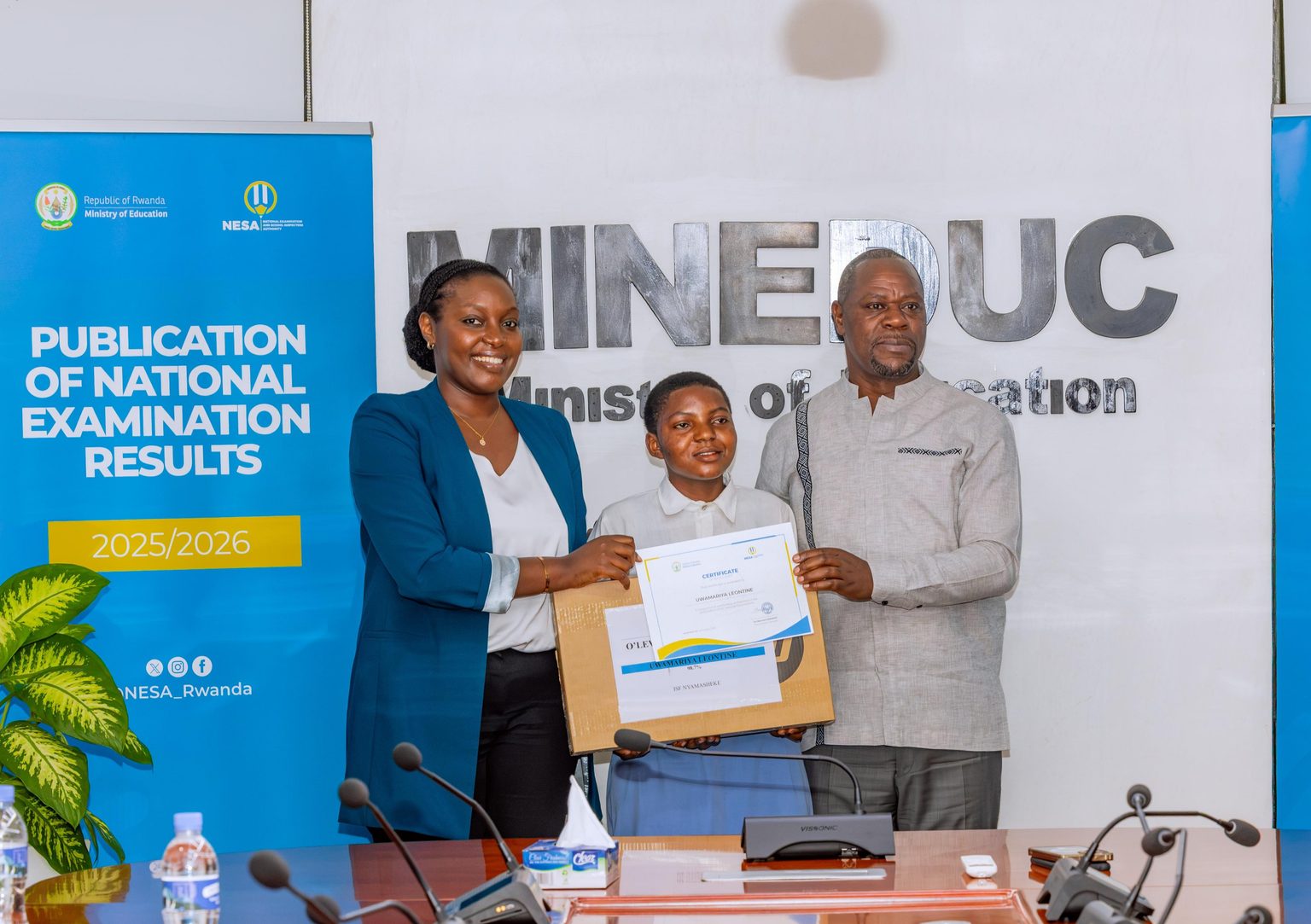
Although she tied for first place nationally at O-Level with 98.7%, Uwamariya was not present when top-performing students were recognised at the August 20 ceremony.
Her absence generated questions on social media about why a student who had achieved the highest score could not be reached.
The Ministry of Education later explained that the problem was linked to contact information recorded in the Student Data Management System. State Minister for Education Claudette Irere said officials had attempted to contact Uwamariya, but an incorrectly recorded telephone number complicated communication with her family.
The ministry subsequently invited Uwamariya to Kigali on August 21, where she received her awards from Irere in the presence of NESA Director General Dr Bahati Bernard.
The episode ended with Uwamariya receiving not only her examination awards but also an opportunity to continue her studies at Rwanda Coding Academy in Nyabihu District, a specialised institution focused on technology and computing.
Uwamariya said the opportunity would help her pursue her ambition of becoming a technology specialist.
Boys continue to outperform girls at O-Level
Despite the overall improvement, the results also reveal a gender gap that remains relevant to Rwanda’s education debate.
At O-Level, boys recorded an 89.8% pass rate compared with 82.63% among girls. (The New Times)
The difference suggests that rising national performance does not necessarily mean that all groups of learners are benefiting equally.
At a time when Rwanda continues to place strong emphasis on girls’ education and participation in science, technology and other high-demand fields, the gender gap at O-Level remains an area that warrants closer attention.
More students, but more pressure ahead
The increase in the number of candidates also presents a challenge beyond examination performance.
Education officials have warned that the growing number of learners could put pressure on the capacity of schools, particularly where the expansion of school infrastructure and staffing does not keep pace with enrolment growth. (The New Times)
This is important because passing an examination is only one stage of a student’s education journey.
For thousands of learners completing primary and O-Level education, the next challenge is finding sufficient places, teachers, learning facilities and resources to continue their studies.
The government therefore faces the dual task of maintaining the gains reflected in this year’s results while ensuring that increasing numbers of students can access quality education beyond the examination stage.
Beyond the pass rate
The 2025/26 examination results offer an encouraging picture of Rwanda’s education system, particularly given the sharp rise in national pass rates.
But the figures also point to questions that extend beyond how many students passed.
Why are some districts performing considerably better than others? Why does a significant gender gap remain at O-Level? Can school capacity expand quickly enough to accommodate rising numbers of learners? And can strong examination results translate into deeper learning, practical skills and successful transitions into further education and employment?
Those questions will matter as much as the headline pass rates in determining whether Rwanda’s latest improvement represents a temporary rise in examination performance or part of a sustained improvement in learning outcomes.
For now, the 2025/26 results provide both cause for celebration and a new set of challenges for Rwanda’s education sector: more students are succeeding, but the system must now ensure that the gains are broad, sustainable and matched by opportunities for every learner to progress.
theinspirerpublications@gmail.com



Leave a Reply