
Rwanda banks on digital innovation to ensure accessibility, affordability of quality seeds to farmers
By Elias Hakizimana.

Rwanda seed sector will be boosted by digital innovation to ease accessibility and affordability of locally produced quality seeds to farmers.
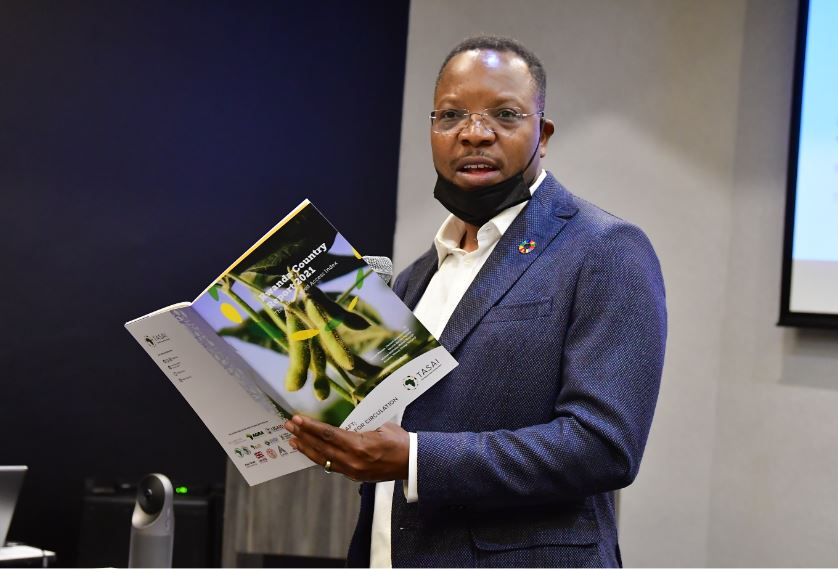
This was announced at a regional dissemination meeting that assesses Rwanda country report 2021 on status of seeds by the African Seed Access Index (TASAI) that was held in Kigali on Tuesday, 07 December 2021.
The comparative report on seed accessibility that is conducted every two years involved three respective countries, Rwanda, Kenya and Malawi and; each country has its own report with shared efforts with seed sector experts from the mentioned countries.
The report highlights developments in the formal seed sector between the last study conducted in 2018 and 2020. It focused on maize, bean, wheat, and soya bean which are the most important crops for food security in the country.
Dr. Clement Urinzwenimana, Consultant Researcher on Agriculture and seed system who also participated in making Rwanda country report available said that there is a good progress in quality seed availability, accessibility and affordability to farmers as active breeders and seed companies increased comparing to the findings from the previous report of 2018.

“We did the research on the Africa Seed Index to assess the status of seed industry on different countries so that we develop the sector. Today’s research focused on maize, bean, wheat, and soya bean and we are happy for a good progress. Besides these seeds, multipliers are working on other crop varieties and we appreciate the country’s legal framework that was established to fast track sector development.” Urinzwenimana said.
The move, he said, tackled the issue of seed imports as they are produced locally.
Eliminating fake seeds
Urinzwenimana said that Rwanda used to import seeds from Zambia, Zimbabwe and South Africa and without local research in Rwanda.
“Today seeds are tested in Rwanda and this eliminated the issue of fake seeds. Rwandan Researchers work hand in hand with the citizens to reduce seed imports.” He noted.
He said that over 80 percent of farmers who use consolidated land use quality seeds with the government’s subsidies.
Daniel Rwebigo, Seed System Division Manager in Rwanda Agriculture and Animal Resources Board (RAB) said that the report is a pivotal document for the government’s seed sector as it helps to build on the available achievements and challenges to better plan ahead with necessary solutions to improve services and sustain the sector.
Boosting digital seed system
Currently, Rwanda used Smart Nkunganire digital seed system to sell and follow on subsidized seeds including maize, wheat and soya beans.
Rwebigo said that they want to put in more seed varieties to expand the system.

“We need to add beans and Irish potatoes for example and make them available to farmers, there is another system that is being established to help monitoring seeds and their management and I believe that both systems once fully operational, will help farmers to get seeds easily.” He said.
During 2018-2020 Africa Seed Index, 153 crop varieties were released. These include 45 maize varieties, 11 varieties off soya beans, 15 of Irish potatoes, 19 of beans, 20 of rice, 27 of potatoes and 16 of wheat.
110 out of the total 150 crop varieties were bred and multiplied by RAB while 43 varieties were bred and multiplied by private companies.
“Today we are happy as we have an increased number of seed varieties and we put much efforts to get more in order to find out solutions to available problems such as food security, food processing, to increase produce on small scale land and on hectare.” Rwebigo said.
Existing challenges
One of the challenges as Rwebigo noted is negative mindset of smallholder farmers who are still reluctant to use hybrid seeds as only 35 percent of them embraced the move.
“Following the continuous implementation of PSTA4 (Five-year government programme of 2018-2024), we wished to reach 75 percent of big-holder farmers who use quality seeds and we exceeded that. For smallholder farmers the target is to move from 35 to 50 percent.” Rwebigo said.
According to Rwebigo, this year’s seasons, 7,000 tonnes of hybrid maize seeds were available in the country and 60 percent of them was bed locally. Wheat seeds increased from 800-900 tonnes to 1,400 tonnes and soya beans from 400 to 530 tonnes and; last year maize increased to 4,600 tonnes.
Seed multipliers speak out
Birungi VB Martha, a Private seed multiplier and Director General of Ebenezer Mixed Farming Company based in Eastern-Rwanda, Gatsibo District in Rewimbogo sector who currently works on hybrid maize crop since 2014 said that she has grown 21.73 tonnes of which only 1 tonne was sold.

She said this is due to the current system which is not streamlined as well as the sunny climate that hindered farmers’ activities.
According to Prof. Edward Mabaya, the Principal Investigator and founder of TASAI, there is need for government involvement to streamline seed sector.
Mabaya affirmed that there is huge reduction of fake seeds following the performance of countries in improving the sector since 2018.





Leave a Reply