
AGRA renews African food-systems alliance with new partnerships to turn farm gains into prosperity
By Elias Hakizimana.
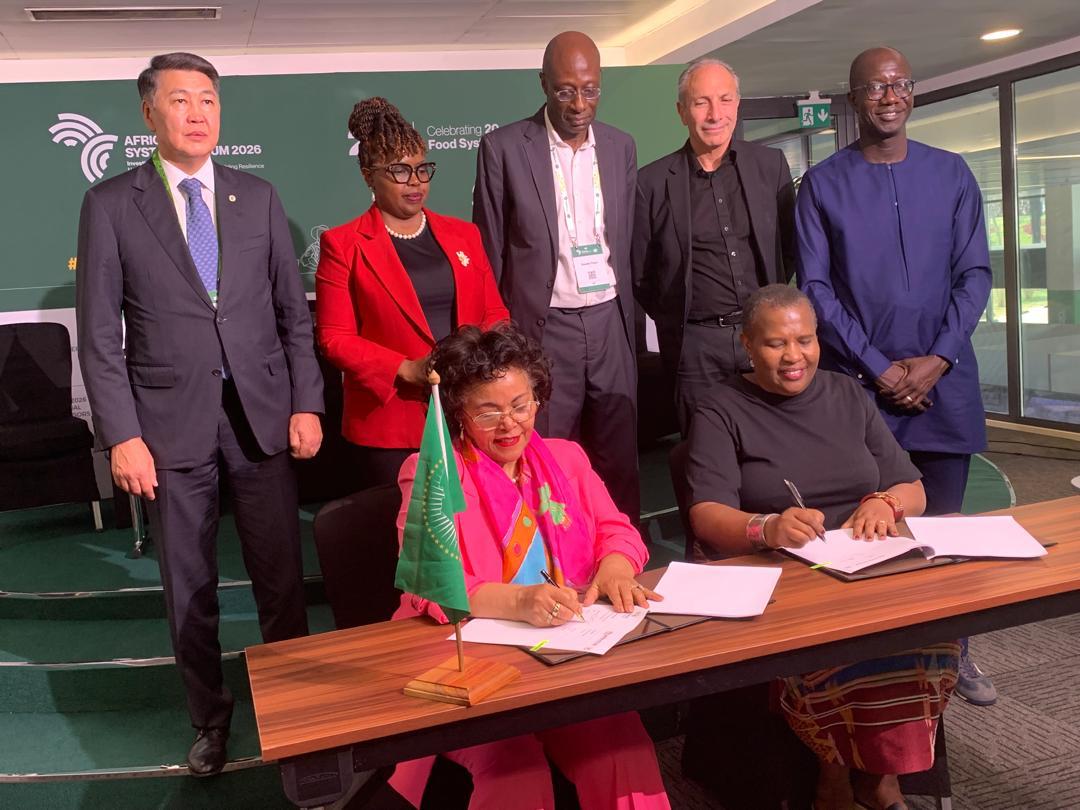
AGRA has renewed its push to transform Africa’s agricultural gains into jobs, trade and higher incomes, signing a series of new partnership agreements with organisations working across food security, trade, nutrition, soil health and investment.
The agreements were signed in Kigali as AGRA marked 20 years of work in Africa’s agriculture sector and unveiled a new impact and foresight report assessing the continent’s progress and outlining priorities for the next phase of transformation.
The report’s central message is that Africa has made substantial progress in agriculture, but increased production has not yet translated into prosperity for farmers at the scale required.
AGRA President Alice Ruhweza said the continent now needs to address three interconnected challenges: raising productivity, converting productivity into economic value and strengthening institutional capacity.
“We have made a lot of progress, but that progress hasn’t yet translated into prosperity,” Ruhweza said.
She said increasing yields remains essential, but production must be connected to value addition, agro-processing, jobs, economic growth and trade.
“Productivity then needs to become value. It needs to become value because when it creates value, it creates jobs, it creates economic growth, it creates trade opportunities,” she said.
The renewed alliance was formalised through agreements with several partners, including Trademark Africa, the Islamic Organization for Food Security, the International Fertilizer Development Center (IFDC), the Global Alliance for Improved Nutrition (GAIN), and the African Union Development Agency-NEPAD.
The agreements reflect AGRA’s broader shift from a traditional focus on soils, seeds, markets and policy towards a wider food-systems agenda encompassing trade, investment, climate resilience and nutrition.
Trade partnership targets Africa’s food corridors
One of the key agreements was signed with Trademark Africa, with the initial partnership focusing on food corridors and improving the movement of agricultural commodities across the continent.
Alan Simoe of Trademark Africa said the organisation had invested heavily in reducing border delays, improving ports, building roads and introducing digital systems across 23 African countries.
But she said infrastructure and trade facilitation alone had not been enough to generate the expected gains in agricultural trade.
On the Northern Corridor, she said, the time required to move goods from Mombasa to Kigali had fallen from about 21 days to five days.
However, much of the resulting efficiency had benefited imports and transit rather than agricultural production and processing.
“Without the productivity, there’s nothing,” Simoe said. “Without the connections to what is being actually traded, we were not seeing those efficiency gains actually translating to increased trade and prosperity.”
The partnership with AGRA will initially focus on strategic food corridors, including those used to move grain and horticultural products within Africa and to external markets.
Simoe said the collaboration could help tackle Africa’s continued dependence on food imports despite its agricultural potential.
New agreements broaden the alliance
The Islamic Organization for Food Security signed an MOU with AGRA to strengthen food-security governance and regional policy coordination.
The agreement covers capacity building for agri-food institutions, investment mobilisation, access to technology, markets and finance, and climate resilience.
IFDC also renewed its partnership with AGRA, building on two decades of collaboration around soil health, fertilizers and sustainable agricultural transformation.
Meanwhile, GAIN is joining the renewed alliance with a focus on nutrition and access to healthy diets.
GAIN Managing Director Lawrence Haddad said about two-thirds of Africans — around one billion people — cannot afford a healthy diet.
He said the partnership would work to increase the production and consumption of nutritious foods, support small and medium-sized enterprises connecting farmers to markets, and encourage stronger consumer demand for healthy diets.
AU agency calls for coordinated action
The African Union Development Agency-NEPAD also signed an agreement with AGRA, reinforcing the importance of coordination, accountability, investment and resource mobilisation.
The agency’s representative said Africa’s development efforts had been weakened by fragmentation and that greater coordination was needed to deliver measurable impact.
The agency will work with partners to strengthen policies, regulatory frameworks and investment conditions while helping translate development priorities into bankable and investable opportunities.
The partnership approach is intended to bring together the respective strengths of governments, development organisations, businesses and technical institutions under shared priorities.
AGRA’s Ruhweza said the organisation would be more intentional about partnerships in its next phase, with an emphasis on ensuring that agreements result in concrete action and measurable outcomes for farmers.
“We want these partnerships to mean something,” she said. “We want these partnerships to be able to work with us to support the African farmers’ prosperity.”
The signing ceremony came at the close of the Africa Food Systems Forum in Kigali, providing a practical follow-up to discussions throughout the week on agricultural productivity, food trade, investment, climate, nutrition and resilient food systems.
For AGRA, the next chapter is therefore not simply about producing more food.
It is about building the systems that can turn what African farmers produce into greater value, stronger markets, more jobs and lasting prosperity.
theinspirerpublications@gmail.com



Leave a Reply