
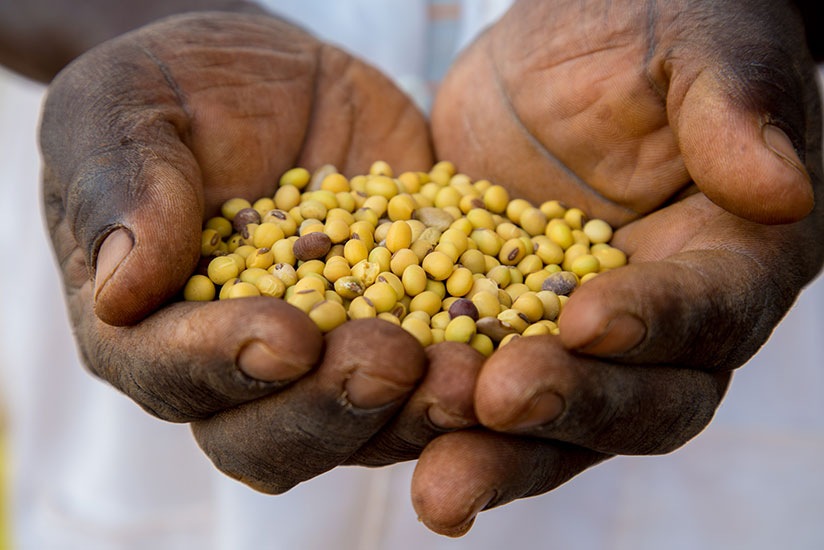
Rwanda Allocates Over Rwf54 Billion for Farm Inputs in 2024/2025
By The Inspirer
The Rwandan government has set aside over Rwf54.2 billion to subsidize mineral fertilizers and selected seeds—namely maize, wheat, and soybean—for the fiscal year 2024/2025, as confirmed by the Rwanda Agriculture and Animal Resources Development Board (RAB).
This allocation is only slightly lower than the Rwf54.6 billion budgeted in the 2023/2024 fiscal year. It includes Rwf10.6 billion for seeds and Rwf43.6 billion for fertilizers, according to RAB.
Approximately 65% of the farm input subsidies will be utilized during the agriculture season 2025 A, running from September 2024 to February 2025. With this financial aid, farmers can purchase urea fertilizer—essential for crop nitrogen supply—at a significantly reduced rate of Rwf660 per kilo, down from the regular price of Rwf1,003, thanks to a 34% subsidy.
Significant reductions on fertilizer prices
For DAP fertilizer, commonly used in maize farming, farmers will pay Rwf724 per kilo instead of Rwf1,298, benefiting from a 44% subsidy. Similarly, those using NPK 17-17-17 fertilizer for potato farming will pay Rwf684 per kilo, instead of the usual Rwf1,146, due to a 40% subsidy.
Farmers growing maize, wheat, and soybean will also receive substantial support, with the government covering over 50% of the seed costs.
Farmers welcome support amid rising costs
Farmers across Rwanda expressed appreciation for the subsidies. Charles Uwamungu, a potato farmer from Musanze District, highlighted the importance of affordable farm inputs. He pointed out that farmers using up to 300 kilos of fertilizer per hectare would face steep costs without government support.
“This helps reduce our production costs and increases our yields, especially when we combine mineral fertilizers with organic manure,” Uwamungu said. “With NPK and manure, we can harvest up to 20 tonnes per hectare, while relying solely on manure yields only around eight tonnes.”
Jonathan Niyizanderera, a rice farmer from Rusizi District, noted that the subsidies would reduce reliance on expensive loans to purchase fertilizers and seeds.
“If we didn’t have these subsidies, I would either farm on a smaller plot or take out loans, which could wipe out any profits,” Niyizanderera remarked. He stressed that the subsidies are crucial for farmers seeking to make agriculture a profitable venture.
Massive Uptake of Seeds and Fertilizers Projected
The government anticipates that more than 6.8 million kilos of seeds will be distributed to farmers during this fiscal year. These include over 5.7 million kilos of maize, 912,000 kilos of wheat, and 214,600 kilos of soybean. For fertilizers, projections indicate that over 78.5 million kilos will be used across the country.
The total includes 30 million kilos of DAP, more than 20.5 million kilos of urea, and over 24.2 million kilos of NPK17-17-17. Blended and micronutrient fertilizers will account for more than 3.6 million kilos, according to RAB.
Florence Uwamahoro, Deputy Director General of Agriculture Development at RAB, emphasized that the fertilizer estimates align with the approved budget but stressed that the institution encourages increased uptake of farm inputs to boost yields.
“When the planned budget is exceeded, we consolidate data and advocate for additional funding from the Ministry of Finance and Economic Planning,” she explained. “Our goal is to avoid limiting farmers’ access to inputs based on budget constraints.”
Currently, Rwanda’s average mineral fertilizer usage stands at 72 kilos per hectare. Under the second National Strategy for Transformation (NST2), the country aims to increase this to 94.6 kilos per hectare. Additionally, RAB data shows that around 40% of Rwandan farmers use quality seeds, with plans to increase this by 10% annually over the next five years under the fifth Strategic Plan for Agriculture Transformation (PSTA5).
theinspirerpublications@gmail.com



Leave a Reply