
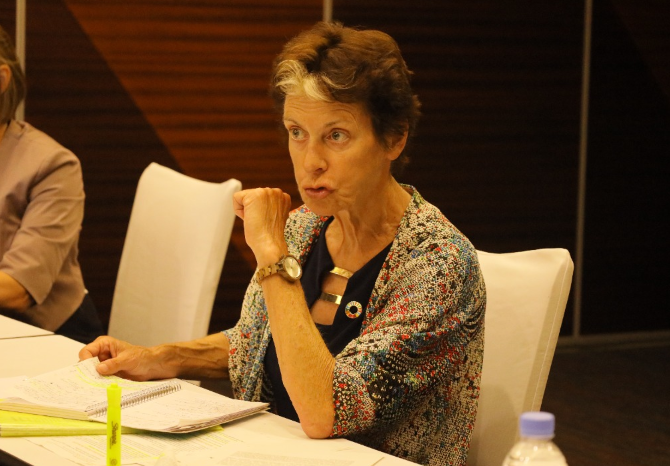
UN Assistant Secretary General suggests solutions to food insecurity in Africa
By Elias HAKIZIMANA.
Food insecurity is an issue that has created debates among many African countries, its impacts made countries to rely on imports according to different reports.
The United Nations Assistant Secretary General and leading expert on nutrition security issues, Ms Gerda Verburg, who is also Coordinator of the Scaling Up Nutrition (SUN) Movement, has suggested some key solutions that can help African countries to leverage finance in ending food insecurity and hunger on the continent.
The Inspirer’s Elias Hakizimana had an exclusive interview with Ms Verburg, who has been in Kigali with senior government officials in the African Green Revolution Forum (AGRF-2022) and came up with significant and educational news content in questions and answers structure.
Three important questions and answers lead the excerpts in this contents.
Africa relies heavily on food imports according to reports: What do you think Africa should do to reduce the import bill?
Africa spends every year about $ 60 billion on food imports, this is linked to Covid-19 and the impacts of the crisis Russia-Ukraine, it is a challenge to African governments and countries that they need to look solutions for. What they need is to re-invest in their own food systems because most countries are now neglecting the production of traditional crops, because they are able to import heavily subsidized foods, wheat for instance.
Going forward, they need to introduce nutritious crops like cassava, cereals and all that we have in Africa. Farmers know how to work on it, very often, they are very good also for the soil, and farmers need to improve the soil to have good climate impacts.
My suggestion is that African countries and governments can agree on decreasing imports because it takes a cost, but they can start to invest in transitioning food systems. They do not need to start from scratch, because most of the African countries have many food systems, national pathways that they need to implement and make actionable. But, it is important to note that new food systems require some criteria. First, is to introduce healthy, nutritious and affordable food, second is to provide farmers and food producers and people along the food value chain with decent jobs for decent income, third is that they must be climate friendly, because climate change is also increasing and countries become vulnerable.
Most of African countries are developing and least developed: How can they leverage finance to end food insecurity and hunger?
The problem with many countries is that they are heavily indebted, Covid-19 has already created more debts for countries, but also the current crisis situation with high prices for fuel, food and fertilizers, I think African countries should request the UN but also the international financial institutions, to find solutions because a country that is not able to invest from domestic projects is really dependent from donors and other investors. […….] My view, as a movement’s view, is that governments of every country needs to be responsible for their own nutrition, own education and own food systems. They cannot invest everything but, by investing from the domestic projects shows that they are emphasizing ownership and they show that they are stepping up, so, invest from your domestic project and the SUN Movement will be more than happy to support you in rolling other investors and funders and philanthropy behind the government’s investments.
Youth and women are key players in agriculture sector and food systems: What do you think should be special packages to them to boost this sector?
Not really packages, I think, but there are crucial, let me emphasize more on this! Youth want to make good living, they are eager to use new technologies, there is need to make sure that technologies that will be used can also be used in rural areas and can improve farmers’ income, where they can start processing food. Women need to have equal rights and equal access, and should not be underestimated. In too many countries women are still excluded while at the same time in Africa food producers are almost half composed by women. So, equality as a rule, not special packages. There is need for looking for structural solutions in nutritional security on average, because in a country where there is really equality between the genders, they take seriously not only decision making, but also implementation and execution, so they are very likely to make best progress and create business sustainability for the future.
Ms Verburg is the former Minister of Agriculture and Food for the Netherlands, and was appointed by the UN Secretary General to lead the Scaling Up Nutrition Movement as its Coordinator. She is a leading expert on nutrition security issues.



Leave a Reply