
Rwf 1 billion liquid nitrogen plant to boost cow semen storage in Eastern Rwanda
By The Inspirer.
By the end of the 2024/2025 fiscal year, residents of the Eastern Province will have a new facility constructed—a plant that will produce liquid nitrogen for storing cow semen.
This gas is essential for cooling various substances, reaching temperatures as low as -196°C. It is used in a range of industries, including machinery cooling, food preservation, and medical applications such as the proper storage and transportation of blood and semen.
In Rwanda’s livestock sector, this liquid nitrogen is crucial for safely storing cow semen, which must be kept at extremely cold temperatures to prevent damage. The new plant, set to be built in Kayonza District, will cost around one billion Rwandan Francs (Frw).
Dr. Solange Uwituze, the Deputy Director General in charge of Livestock Development at the Rwanda Agriculture and Animal Resources Development Board (RAB), told IGIHE that the plant will have the capacity to produce 2,000 liters of liquid nitrogen per hour.
“It is a plant that will be built in Kayonza, with a total cost of about 1 billion Frw. Currently, we get this liquid from two existing plants, one in Rubona (Huye District) and the other in Rubilizi (Kigali City),” she explained.
These other plants also have the capacity to produce 2,000 liters of liquid nitrogen per hour, which is used for storing and distributing semen from elite bulls at RAB’s Songa Station in Huye District.
This station, located in Kinazi Sector, spans 393 hectares, which are dedicated to breeding bulls that provide high-quality semen.
The new project will benefit Eastern Province farmers, who are known for large-scale livestock farming, by providing them with semen storage closer to home, thus increasing productivity. Currently, these farmers face challenges, such as delays in receiving semen and unsuccessful insemination, leading them to resort to using natural bulls.
A livestock farmer from Nyagatare District, William Bindebe, shared, “Most of the time, the insemination doesn’t work. I’ve tried artificial insemination on four cows, and none of them conceived. I even paid for the service, but I was left confused and decided to return to using natural bulls.”
Another farmer from Nyagatare, Peter Muyango, expressed similar frustrations, stating that semen storage had been poorly managed, and it was difficult to find inseminators when needed.
“When you call the vet, they are often out working with other farmers, and by the time they arrive, the cow is no longer in heat. They need to be paid, and even then, the insemination may not be successful. Having semen stored closer would help a lot,” Muyango said.
The Rwandan government has committed to using technology in agriculture and livestock farming in a direct and practical way. For instance, today, pig farmers can access semen in a very short time thanks to drones.
When asked if this technology could also be used to quickly deliver cow semen to farmers, Dr. Uwituze explained that it is more complicated due to the much colder temperatures required for storing cow semen compared to pig semen.
“[Transporting cow semen via drones] is challenging. The reason is that pig semen is stored at 17°C, making it easier to transport via drones. However, cow semen requires extremely cold temperatures (-196°C), which makes drone transportation difficult,” she said.
She further explained that it is challenging to ensure such low temperatures in the small packages transported by drones, but she confirmed that research is ongoing, in collaboration with Zipline Rwanda, a company specializing in drone deliveries.
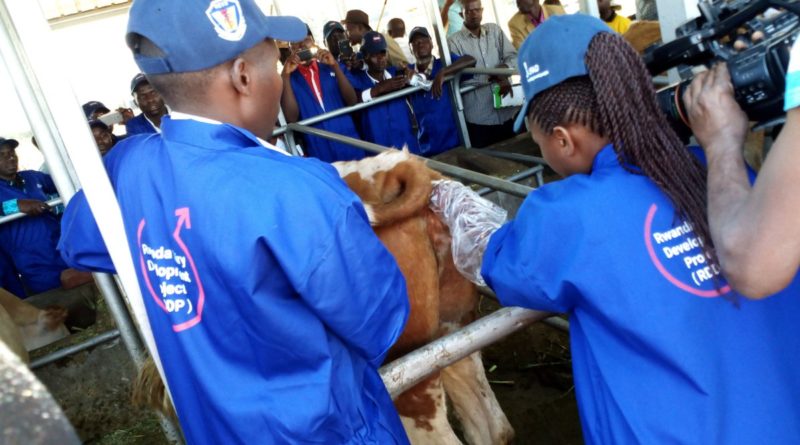
Artificial insemination is one of the modern methods recommended to farmers to increase milk production and prevent diseases that could be transmitted by natural bulls.
Statistics from the Ministry of Agriculture and Animal Resources indicate that in the 2023/2024 fiscal year, 109,209 cows were inseminated using modern methods.
Over the past seven years, Rwanda has made significant efforts to develop agriculture and livestock farming, which have resulted in milk production reaching one billion liters. This is an increase from 776 million liters, and the number of milk collection centers also grew from 56 in 2017 to 134 today.
These achievements have been supported by various programs aimed at increasing the number of cows, including the Girinka program, which has distributed cows to many families. As of May 2023, Rwanda had 1,644,692 cows, including those given through the Girinka initiative.
theinspirerpublications@gmail.com





Leave a Reply