
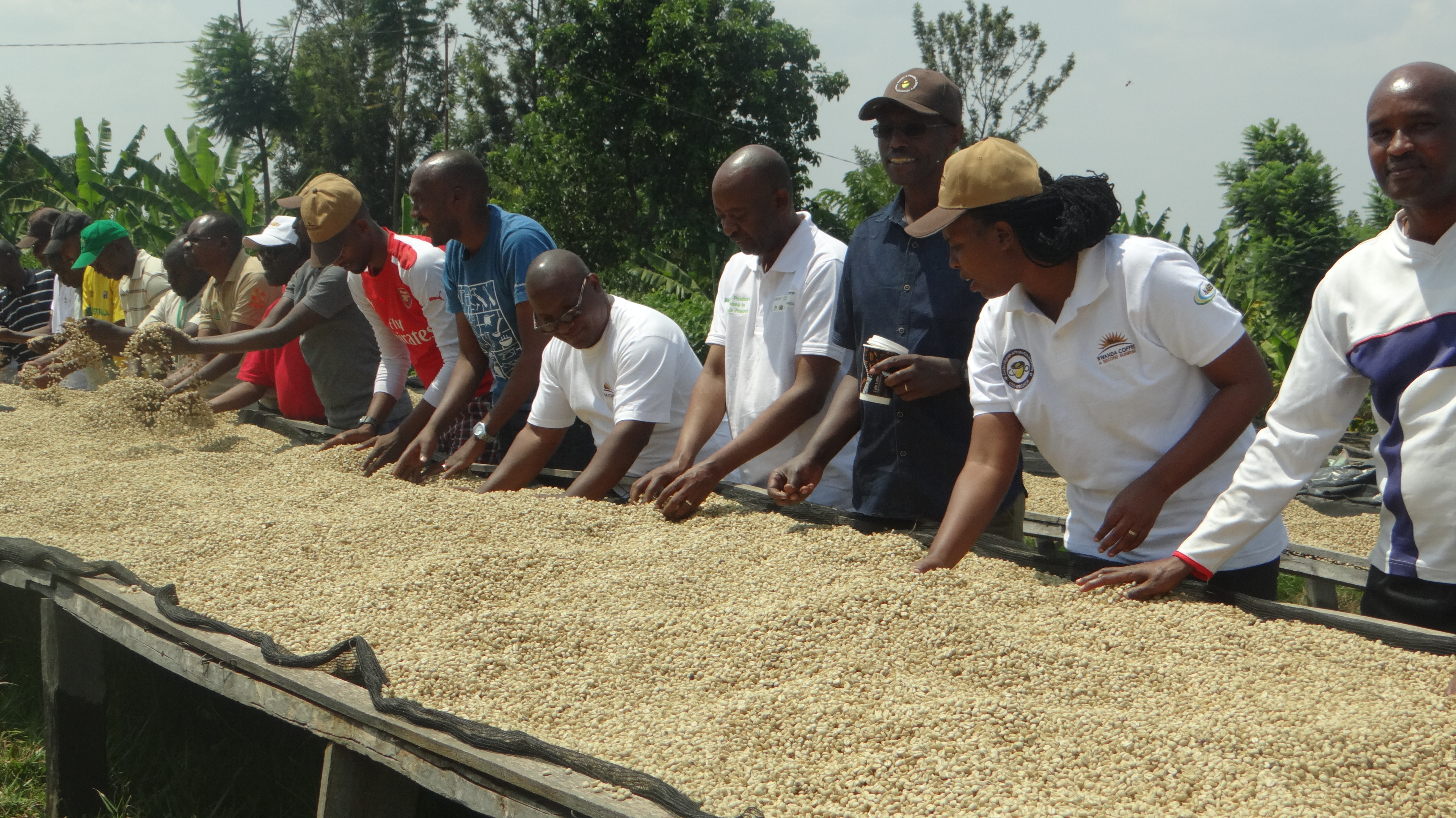
Rwandan coffee farmers testify how the crop improved their lives
By Elias Hakizimana.
Rwanda’s coffee farming sector has made a significant progress as farmers say their daily activities in relation to coffee growing, processing and trading make significant incomes that transform their lives.
The sector is source of livelihoods for over 350,000 farmers engaged in growing coffee countrywide, with over 89.7 million coffee trees planted on an area of over 35,000 hectares, according to information from the Ministry of Agriculture and Animal Resources (MINAGRI).
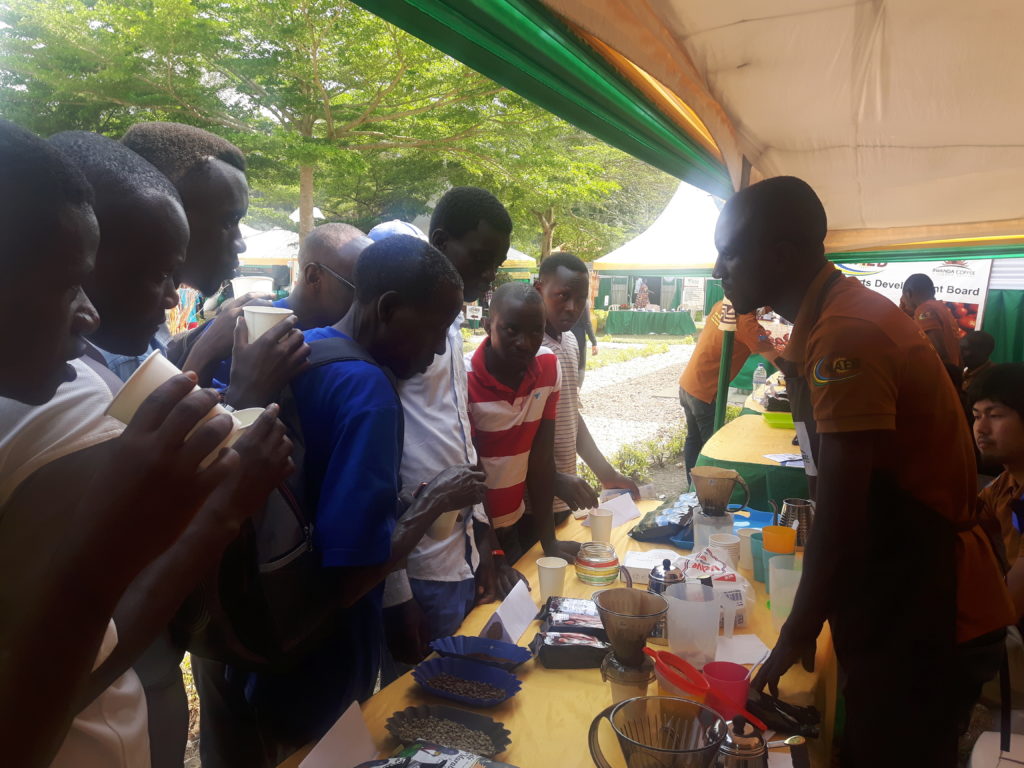
During the ongoing Rwanda 14th Agrishow 2019, some of farmers from various cooperatives countrywide are sharing experience and the journey to good and quality produce of coffee for both local and international markets.
Marthe Uwanyirigira, a farmer and representative of KOTEMUKAMA, a cooperative growing coffee in Macuba Sector, Nyamasheke District in Western Province said her engagement in coffee cultivation roots in her childhood as she was born in a family and a neighborhood that grows coffee.
She learnt to plant coffee trees as she grew up and later joined a cooperative. Uwanyirigira has 1,500 coffee tree plantation that can enable her to save Rwf2 million in profit per season.
“Growing coffee is vital and mostly important in raising community welfare, I gain profit and I employ other people in coffee farm and in the factory,” Uwanyirigira said.
Their cooperative that comprises of 232 members from 69 at the beginning has built a factory to process coffee and they export green coffee in USA.
One of the challenges coffee farmers still face is delay of pesticides and fertilizers.
Xavier Niyomugabo, another farmer from KOPAKAKI Cooperative, which grows coffee in Bwishyura Sector, Karongi District in Western Province said since their beginning of activities as a cooperative in 2007, their members increased from 70 to 1,184 due to good understanding of the role of growing coffee.
Of the cooperative’s 1,184 members, 479 are women while 705 are men. “We built a factory under the government loan and we paid it, coffee is important for my daily life, my parents used it to pay my school fees and I built a good residential house because I grow coffee,” he told The Inspirer.
With JICA and NAEB project dubbed ‘Coffee Upgrade and Promotion in Rwanda (CUP) that trains farmers on best coffee plantation and processing from farm to the factory, Niyomugabo and his colleague-farmers say they train other farmers how to prepare and drink coffee at home.
He also requests National Agriculture Export Development Board (NAEB) to increase efforts in delivering pesticides and fertilisers to farmers on time in a bid to avoid losses induced by delays in the distribution of farming inputs.
Dorick Uwizeye, Representative of Rwanda Small Holder Specialty Coffee Company (RWASHOSCCO), a farmer-owned coffee marketing, exporting, and roasting company says that they work with six cooperatives and target to expand the local market. She says that with the era of internet, they use e-market to supply coffee to some of their clients.
Uwizeye is also showcasing best practices in coffee growing and use in the Agri-show.
Alexis Ndayisaba, CUP project officer says the three year-project started with two cooperatives in western province to support farmers increase quality in the whole value chain from nursery to the washing station and connecting them with markets.

“In order to share knowledge, we invite Rwanda Coffee Cooperatives’ Federation (RCCF) to select some cooperatives to learn from others for the interests of learning the best practices. So, the mindset was one of the challenges that was changed through that networking and quality of coffee was improved,” Ndayisaba notes.
He says that CUP gained 15 foreign buyers during the recent African Fine Coffee Association Meeting in Kigali who requested coffee samples and will be sent this June 2019.
“In November 2019, we are planning for a field workshop to Colombia, the country that has a big number of coffee farmers to learn from them, and from July, we will organize baristas’ competition countrywide to sustain the quality of coffee,” he adds.
Overall, Rwanda exported 23,000 tonnes of coffee in the financial year 2017/2018, generating $67 million. It produced 24,500 tonnes in 2018/2019 which are expected to generate $75 million, according figures from NAEB.
theinspirerpublications@gmail.com




Leave a Reply