
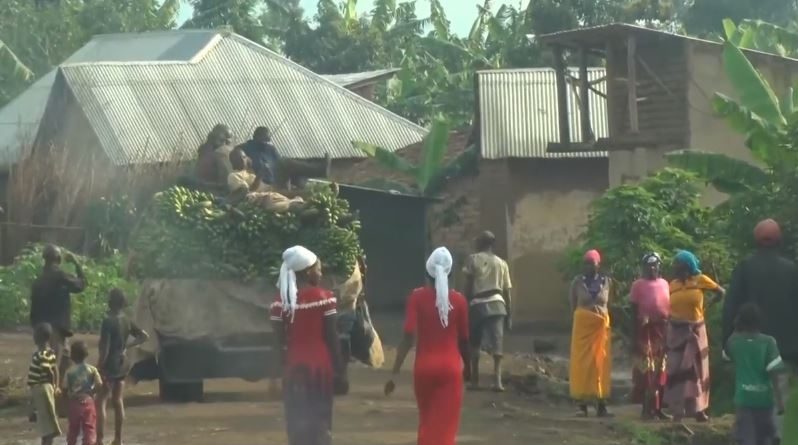
Rubavu: Traditional culture and taboo impede reproductive health education
By Elias Hakizimana.
Adolescent girls in Rubavu district blame their parents to be the main cause of early pregnancies as they are still reluctant in educating them on Sexual and Reproductive Health.
Some of these teenagers say that their parents give them some education on this subject; others say that they are not educated while others say that their parents also do not have the knowledge on sexual reproductive health.
Ruth Nibishaka, 17, is one of adolescent girls interviewed by AFRICANA POST NEWS in Rwangara village, Murambi Cell, Rubavu Sector. She says their teacher at the school where she was studying told them that a girl can be in a menstrual period and gets pregnant right away when she does unprotected sex.
It has been made clear that most teenage girls do not have a clear understanding of sexual reproductive health.
Nibishaka says parents are less likely to talk to their children about reproductive health because often when they are asked about it they reply negatively to children saying that they ask nonsense questions.
“In our neighborhood, there is a girl who asked her mother about sexual reproductive health, and she replied, “You’re asking nonsense question”, so, can you ask further when a parent replies you in such an aggressive context?” Nibishaka worried.
Milliam Niyitanga, one of the parents in Rubavu district, Nyakiriba sector, is a 45-year-old mother of eight children, sons and daughters.
She says that as parents, they often talk to their children about reproductive health, but accuses them of being ignorant.
“They do not put in mind what we always teach them, we tell them to be careful and avoid contracting with boys, and instead we find them pregnant.” She said.
She says that girls are likely open to access information from their mothers than their fathers.
“The girl will not ask her father about sexual and reproductive health because she is embarrassed.” She noted.
Ildephonse Sebakungu, another parent said that both parents of the teenage girl are involved in talking to the child about the growth and evolution of their body and thus train them on how to behave during that period of adolescence.
However, he says there is information that the father does not have about this subject, like knowing when the menstrual cycle of the girl starts.
Louis Gahamanyi, an official in charge of Social affairs in Kanzenze sector, Rubavu district told AFRICANA POST NEWS that educating children about reproductive health is still a problem where parents still consider it as a waste of culture, shame or taboo.
“Parents don’t take it so seriously that they talk to their children about sexual reproductive health, instead they consider it as a taboo and they are still building on the culture.” He said.
He added that it is a problem that contributes to early pregnancies among adolescents.
“We are going to sensitize parents in our communities to understand the importance of talking to their children about sexual reproductive health and that they are the first ones to give this education to the children.” Gahamanyi noted.
According to Imbuto Foundation formative evaluation report on first time young mothers in Rubavu district as of December 2018, the main focus associated to teenage pregnancies are looking for money due to poverty in families, orphanage and lack of follow up of parents to their children as well.
Rwanda counted 17,849 teenagers who were impregnated in 2016 and 17, 337 teenagers impregnated in 2017. This number rose to 19,832 teenagers who were impregnated in 2018 and it slightly reduced to 15,656 from January to August 2019.
The Government of Rwanda has put in place significant initiatives through a concerted campaign to better sensitize and educate the public about the future of children. One of these campaigns is called ‘Baho Neza’.




Leave a Reply