
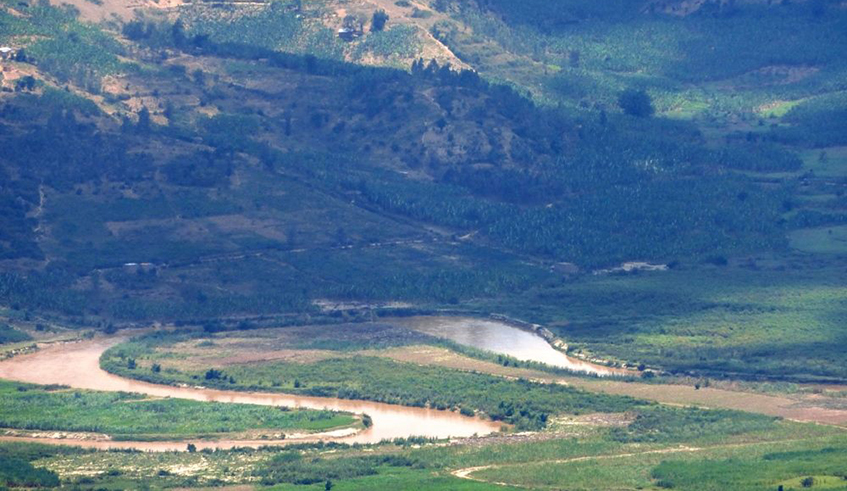
Akanyaru multi-purpose dam to irrigate 12,000 ha on course
By Michel Nkurunziza.
There is “good progress” in implementing Akanyaru multi-purpose dam project as African Water Facility (AWF), which is subsidiary of African Development Bank, has financed the preparation of the project at a cost of $2.36 million.
The African Water Facility (AWF) provides grants and expert technical assistance to implement innovative water projects and raise investment for water projects throughout Africa
The proposed Akanyaru dam project in Gisagara District is situated on Akanyaru River at the border between Rwanda’s Southern Province and Burundi’s Ngozi Province.
Akanyaru River is part of the Kagera River basin that forms part of the Lake Victoria basin and Nile Basin.
The dam on the river is under the Nile Basin Initiative for shared benefits of Burundi and Rwanda.
The project envisages a 52-meter-high dam with a water storage capacity of 333 million cubic metres.
It is expected to generate 14.5 MW of hydropower to supply energy to about 141,111 households with 846,000 people.
The dam will irrigate 12,474 hectares supporting 24,948 farmers, provide food for about 124,740 people, and supply water to 614,200 people from the two countries.
The project also includes restoration of degraded watersheds upstream of the dam.
“We have been able to mobilise recources. African Water Facility (AWF), which is subsidiary of African Development Bank, has prioritized the dam construction in its projects that are in pipeline. They are willing to support the preparation of this project at $2.36 million,” said Isaac Alukwe, Regional Coordinator Nile Equatorial Lakes Subsidiary Action Program Coordination Unit (NELSAP-CU).
Besides the resource mobilization effort, he said, they have been able to bring together Rwanda and Burundi together to negotiate a legal instrument to enable the project implementation.
“So far Rwanda cleared the MOU. Burundi has not yet cleared the MOU. But we have been following up with Burundi, they kept promising, they will clear this MO so that we can proceed with this project preparation. We are optimistic that Burundi will soon be able to clear the MOU and bring together the two governments to sign to allow us to proceed,” he said.
He noted that the process of MOU is a normal dialogue and negotiation of a legal instrument that allows two parties to implement a joint project, especially trans-boundary projects which cut across the boundary at terms that are acceptable to all parties.
“Usually, parties have to sign an understanding on how they will be able to implement that project. The project priorities and components have to capture the interest of both countries. We are now at preparation stage”
Once the project has been prepared in terms of having the feasibility study, detailed designs, environmental impact assessment, the countries will sit together to approve the studies before mobilizing all resources for the implementation.
The countries earlier announced the need for $190 million for the project implementation.
However, Alukwe said the cost might change based on the preparatory studies being carried out.
“This is because things have changed, I remember people have encroached onto the wetlands and even the climate change itself. And also countries have other interests that they would want the project to provide. So, the cost may change depending on the outputs of the preparatory studies,” he noted.
Akanyaru River where the dam will be constructed rises in the western highlands of Rwanda and Burundi as the main tributary of the Nyabarongo river.
Nyabarongo river forms Akagera river which flows into Lake Victoria that is linked to Nile river.
Rwanda and Burundi are members of The Nile Basin Initiative (NBI), an intergovernmental partnership that brings together 10 countries linked to River Nile and these are; Burundi, DR Congo, Egypt, Ethiopia, Kenya, Rwanda, South Sudan, Sudan, Tanzania and Uganda.
More multi-purpose dam projects in Nile basin
The anticipated multipurpose dam along River Nyabarongo will irrigate over 20,000 hectares of crops.
The irrigation is part of a project expected to cater for water supply, irrigation as well as electrical power generation. The project will also mitigate the perpetual flooding downstream of the Nyabarongo River that has proved to be hazardous in recent years.
In February 2020, the Government of Rwanda and the People’s Republic of China signed a framework agreement that will allow China, through China Exim Bank, to extend a concessional loan worth $214 million that will facilitate the construction of the Nyabarongo II Hydropower Plant.
The project will build a 43.5 MW hydropower plant and irrigate 20,000 hectares of land, increasing fishing and tourism activities.
Nyabarongo II Multipurpose Dam under construction is located between the Northern and Southern provinces, specifically between Kamonyi, Gakenke and Rulindo districts.
The dam will measure 59 metres high and 363 metres long, creating a reservoir with a storage capacity of 803,000,000 cubic metres.
Jerome Hitayezu, the Head of the Irrigation Programme at Rwanda Agriculture and Animal Resources Development Board (RAB), said the dam will irrigate the land in the valley of Nyabarongo, Akagera, and Akanyaru rivers as well as upstream of lakes Cyohoha and Rweru in Bugesera District.
The government, in October 2023, also launched the construction of the Muvumba multi-purpose dam, which will cost €121.5 million (approx. Rwf122 billion).
Initially, the Muvumba dam was supposed to be 30.5 metres high and provide 35 million cubic metres of water for irrigation on 7,380 ha and 16 reservoirs for livestock in Nyagatare District, as well as generate electricity.
However, after reviewing the designs, the capacity of the dam was increased. The hydropower station is expected to generate 6.94 GWh annually, an increase from 5 GW.
The dam was envisaged to supply about 24,000 cubic metres per day of water but after design upgrading, this has increased to 50,000 cubic metres per day to 300,000 people in the areas of Karangazi, Rwimiyaga and Nyagatare, in addition to livestock use.
The command area of the irrigation scheme is estimated to increase from 7,380 hectares to 8,800 hectares covering Tabagwe, Gatunda, Karama, Rukomo, Nyagatare, Rwempasha, Musheri and Rwimiyaga sectors. The project will be complete by 2027 if all goes well.



Leave a Reply