

Nyagatare: How complex smart agriculture technologies secured maize farmers from losses
By Elias HAKIZIMANA.
Farmers who are grouped in KOBUKA Cooperative in Matimba sector, Nyagatare District who used to count losses can now smile thanks to the new technologies of smart crop irrigation and crop disease control in the area.
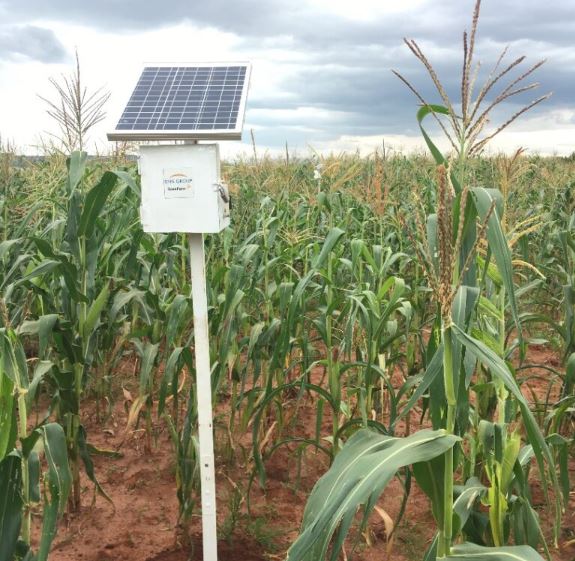
The farmers use two combined technology solutions ‘RindaFarm’ and ‘BazaFarm’ to address both droughts and armyworms and other insects in their maize and vegetable plantations.
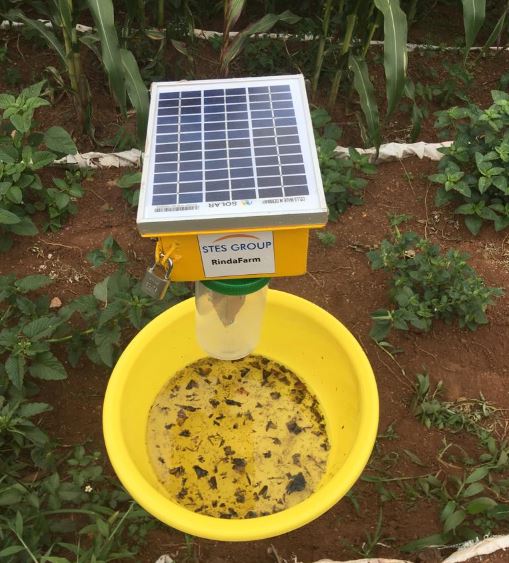
RindaFarm is a technology that is made of a solar powered lamp and a basin with pesticide into water to catch butterflies that grow into armyworms; the light attracts these nocturne insects that are finally trapped by the pesticide. RindaFarm controls a variety of pests including Fall ArmyWorm(FAW), flying nymphs and adults of leaf folder, stem borer moths, fruit borers moths, hoppers, aphids, white flies, fruit weevil and different crop beetles …etc.
BazaFarm consists of installed censors in the farm to detect crop water requirement and it uses self-automated machines that spread water into the entire farm.
These technologies were developed by STES Group Ltd and were spread to farmers through the Rwanda Development Organization (RDO) project under the support of the Rwanda Green Fund (FONERWA).

According to BazaFarm application developer, STES Group Ltd, the Application is a solar powered IoT device that is put in the farm to measure water level, soil temperature and the fertility of the soil in real time and the farmer can access the data on their mobile phone, tablet or PC via Internet and make decisions accordingly. The device helps farmers achieve high yields of crops and also provides data of what the soil needs for the best growing environment of crops.
Testimonies reveal that these technologies doubled maize produce among the users in Nyagatare district.
Muhamad Ngarukiye, 70, a citizen from Kembogo cell, Matimba sector in Nyagatare district who is a member of KABOKU Cooperative that grow various crops including maize on around 900 hectares said that these technologies helped him to double maize produce from 2 and 3 tons to 5 tons per hectare.
“I used to harvest less in the recent years comparing to my investment in maize crop. Because the armyworms could damage quite half of the plantation, I used to spend Rwf30,000 to spray pesticide three times a week. With RindaFarm technology, I only spray once a week and spend Rwf5,000 for pesticide because armyworms were reduced. The smart irrigation guided by automated irrigation machines under BazaFarm technology also help us to increase yield. As a result, I harvested 5 tons of maize in this season worth Rwf 1,1 million,” Ngarukiye said.
 BazaFarm smart irrigation technology
He added that the BazaFarm green technology helps them to get timely information about water requirement in the soil and allows them to grow crops along with the three seasons A,B,C while others who do not use this smart irrigation technology explore only two seasons.
Ngarukiye can save up to Rwf 600,000 from maize yield per season after all expenses including Rwf15,000 for smart irrigation contribution, RWF 15,000 for EjoHeza insurance scheme as well as Rwf6 per 1 kilogram deduction for cooperative membership contribution. They sell the produce to the cooperative at Rwf220 per a kilogram.
Ngarukiye has been doing agriculture since 1994 and paid school fees to all his children. “Now I am saving for the elderly and I ensure food security at home. When I get 5 tons of maize, I take 4 tons to the cooperative and remain with 1 tons to support nutrition.” He said.
Jean Marie Vianney Bigirimana, smart irrigation focal person in KABOKU cooperative explained that the technology uses two systems; pivot that is automated and sprinklers machine that have wheels.
“We have 35 center pivots irrigation machines and 22 sprinklers. Some spread water on 25, 30 and 45 hectares.” He said.
Dismas Rutanga, another farmer on the side of Musheri cell, near the waterway says that their cooperative increased maize yield from 1.5 ton to 6 to 8 tons per hectare.
Teya Mukakalisa, another farmer who grows maize on 0.5 hectare says her produce increased from 2 to 3 tons. She adds that livelihoods were improved as she managed to buy a television to watch at home.
Speaking to The inspirer, Alfred Munderere, Agronomist of Matimba sector reiterated that these technologies supported other initiatives that aim at increasing agriculture production.
He said that apart from maize, the technologies also work for soya beans, beans, green vegetables, and peppers.
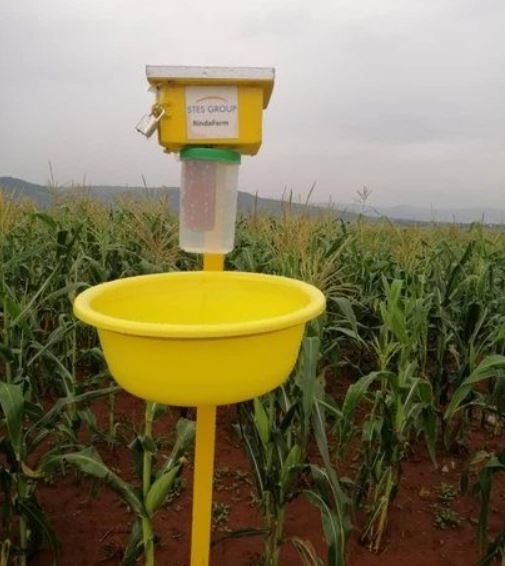
“BazaFarm censors works well especially on maize and soya beans. We can control permanent yielding points of the crop in our Android phones. For RindaFarm, the system lights are on from 6:00 pm until 12:00 am to catch the butterflies, this work as an alarm to help us take further decisions in eliminating armyworms from farms.” Munderere said.
Quite a long ago, Agriculture has become vulnerable to climate change impacts like droughts and crop diseases in Nyagatare District among other affected areas in the Eastern Province.
Since the introduction of biotechnology programme in Rwanda, various Institutions including Rwanda Agriculture and Animal Resources Board (RAB), University of Rwanda (UR), INES-Ruhengeri, and STES Group Ltd have contributed to knowledge expansion to farmers’ communities to go with technologies in improving people’s livelihood.
theinspirerpublications@gmail.com



Leave a Reply