
Gicumbi Youth Agri-Tech Solutions Tackle Livestock Forage Scarcity
By Elias Hakizimana.
Ensuring the availability of sufficient livestock forage is crucial for maintaining animal productivity, especially in dairy farming and meat production. In some parts of Rwanda, particularly in districts like Kayonza and Nyagatare in the Eastern Province, forage scarcity has become a significant issue.
The government, through the Ministry of Agriculture and Animal Resources and other partners, is working to mitigate the adverse effects of drought on livestock and farmers.
Uruhimbi Kageyo Cooperative (UKC) in Gicumbi is addressing this problem by cultivating livestock forage that matures in just seven days using hydroponic forage technology. This initiative aims to solve livestock feed shortages.
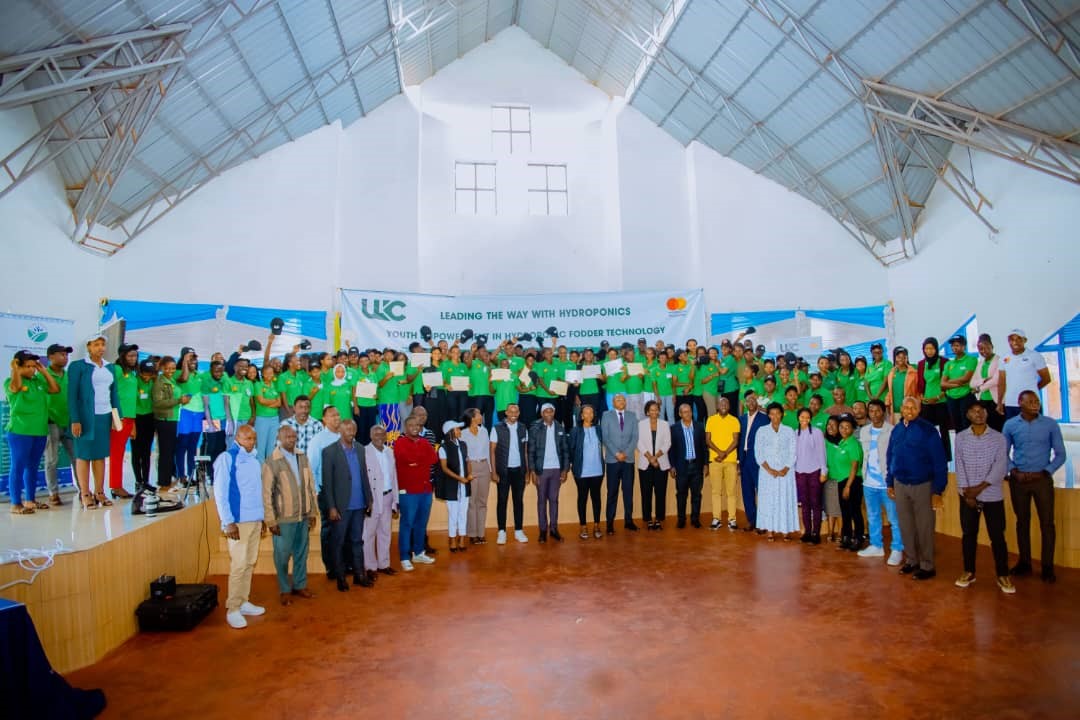
In collaboration with the Mastercard Foundation, the cooperative has trained 158 young people studying agriculture on how to produce this feed so they can implement the practice in their communities or establish their own cooperatives.
Among those trained, 5% are refugees from the Mahama camp in Kirehe District. The group also includes individuals with disabilities and young people with agricultural education.
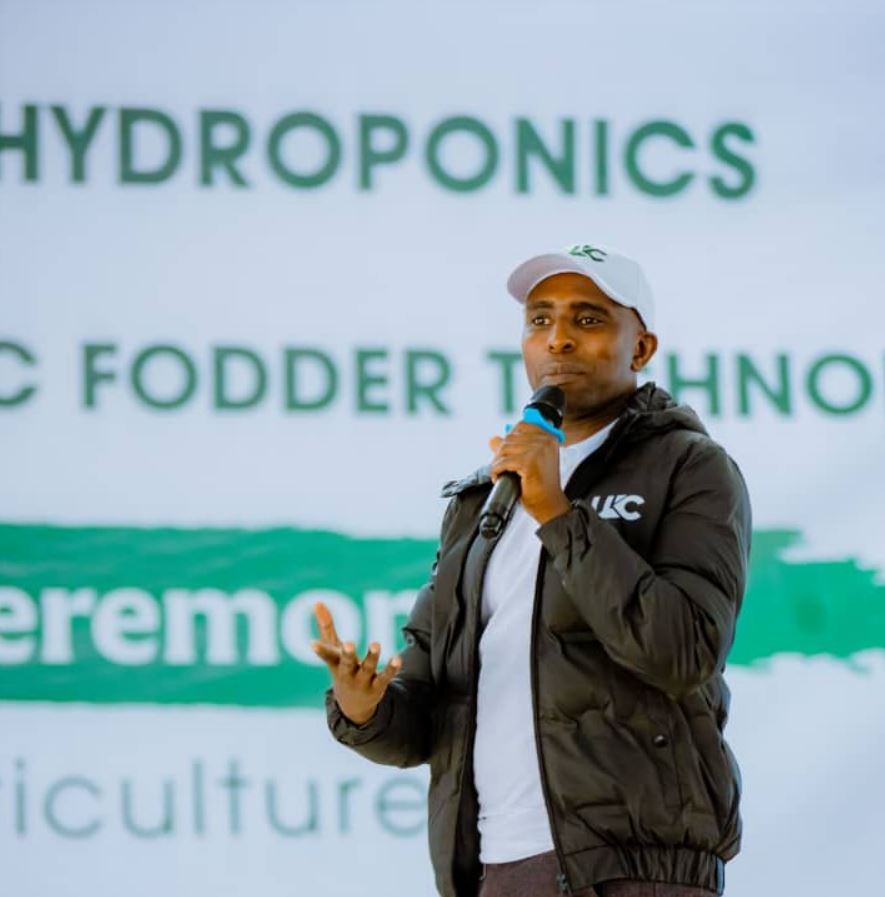
Explaining how the technology works, Jackson Karara, president of UKC, says that the process takes place inside a greenhouse using affordable kits.
“We buy cereals from farmers, including maize, wheat, sorghum, and barley. We first clean them and grow them in aluminum plates where they grow with only water, without soil. This technology does not require fertilizers and pesticides, and it is climate resilient, using a small land area,” Karara explains.

He adds that once the forage matures in less than seven days, it is sold to farmers.
“Our forage is fed to various animals including cows, pigs, chickens, rabbits, goats, horses, and sheep. The forage dedicated to all species of birds, including chickens, ducks, and turkeys, is harvested in four days. For pigs, rabbits, goats, and sheep, their forage matures in six days, while for cows, horses, and larger animals, the forage is harvested in seven days,” he adds.
The outcomes of this technology are promising, and testimonies indicate that animal feed scarcity could become a thing of the past if the majority of farmers embrace this technology. “The results are obvious. On a small plot of 15×8 meters, we can harvest 43 tons of forage per week. It is a good solution for farmers to get enough forage on a small piece of land and in a short period. Another important thing is that this forage is climate resilient, as it can yield in both rainy and dry seasons,” Karara says.
Pricing
The prices of this forage vary according to the type of animal and geographical location, as it is delivered to farmers with an additional fee. One kilogram of cow forage costs between Rwf 90 and Rwf 130, while pig forage costs Rwf 180 per kilogram, chicken forage costs Rwf 280 per kilogram, and forage for goats and sheep costs Rwf 160 per kilogram.
Community-Wide Solution
“We help farmers and anyone wishing to learn this technology by providing in-depth training on how to build a well-equipped greenhouse, how to grow forage in seven days, how to preserve forage, and how to feed animals. Our only challenge is the lack of sufficient cereals. We encourage farmers to grow more and apply best agricultural practices, as quality cereals are necessary for producing quality forage,” Karara says.
Parfaite Uwera, vice mayor of Gicumbi District in charge of finance and economic development, notes that the trained youth in hydroponic forage production have high expectations for bridging the gap in animal feed scarcity. The trained youth will teach fellow young people and farmers as a whole.
Mireille Kazungu, one of the trained youths and a university graduate in biodiversity agriculture, says, “The hydroponic forage production technology is a solution that all farmers must apply because it does not require a large land area and is climate resilient. It will tackle forage scarcity. I am currently a farmer, but I did not know this technology before. I am ready to apply it and encourage fellow youth and farmers to embrace it.”

Prosper Bigirimana, a refugee from Mahama camp in Kirehe District who was also trained, says that this technology will expand in Kirehe and countrywide to tackle forage scarcity.
“I am a graduate in business management and entrepreneurship. As a youth from a refugee camp, I will help other young people and citizens in Kirehe District to apply this technique to provide enough forage for livestock in their areas,” he says.
theinspirerpublications@gmail.com





Leave a Reply