
Dairy farmers to get more income thanks to new milk prices
By The Inspirer
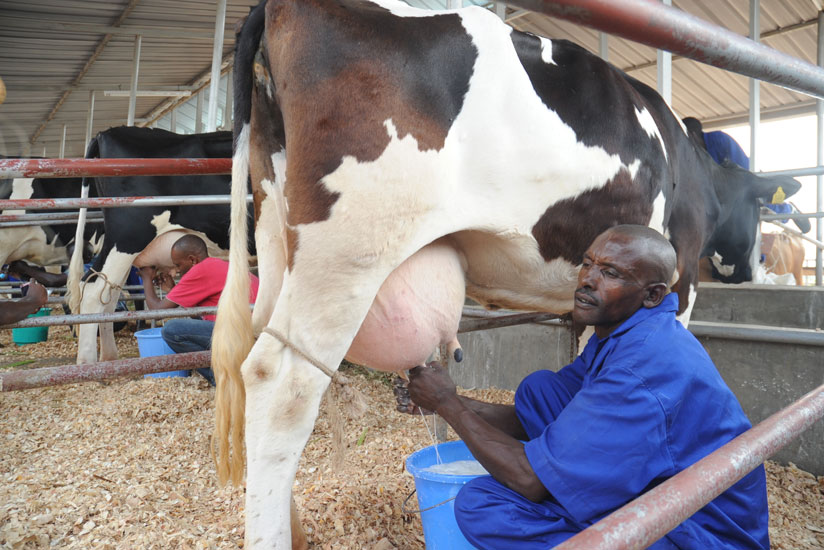
A dairy farmer will be getting at least Rwf28 more income per each litter of milk they sell after the Government set Rwf228 as a new minimum price for a litre of milk. The price represents an increase of 14 percent compared to the Rwf200 a litre which was set in 2018.
The new price is contained in the milk tariff announcement issued by the Ministry of Trade and Industry (MINICOM) on April 6. It was signed by the Minister of Trade and Industry, Beata Habyarimana.
It indicated that the new tariff is based on the two meetings – one held on January 24, the other on March 9, 2022 between MINICOM, the Ministry of Agriculture and Animal Resources (MINAGRI), representatives of livestock breeders and milk collection centres (MCCs).
While Prime Minister Edouard Ngirente was presenting the government actions related to agriculture inputs to both chambers of Parliament on Monday, April 4, some MPs exposed dairy farmers’ complaints that price for their milk produce was still low and wanted it raised.
Ngirente told legislators that a milk price review was underway by MINICOM and MINAGRI in collaboration with other dairy sector players including farmers and factories in order to come up with the right price. He added that the revised one would be announced within a week.
According to the announcement, an MCC will be buying milk from dairy farmers at Rwf228 a litre and sell it at Rwf250 a litre (to consumers). This is an increment of 13.6 percent compared to Rwf220 a litre in the pricing of 2018, which is the recent one.

Also, a farmer or MCC supplying milk to a dairy factory will be getting Rwf270 a litre. In the previous tariff, MCCs would receive the same price for milk once they supplied it to Nyanza Dairy (in Nyanza District), Savanna Dairy in Nyagatare, and Mukamira Dairy in Nyabihu District.
But, still talking about the 2018 tariff, a farmer or an MCC that directly delivered milk to Inyange Industries in Masaka, Kigali, would get Rwf240 per litre of milk.
Agnes Mukangiruwonsanga, the president of IAKIB, a dairy farmers’ cooperative in Gicumbi District said that the new prices are a motivation to farmers as the previous ones were low compared to livestock breeders’ investments.
IAKIB collects between 36,000 litres and 42,000 litres of milk per day, Mukangiruwonsanga said.
“The increase in milk price implies that, at least, the farmer’s concern is being understood and addressed. This is an encouragement to farmers,” she said, indicating that when prices are favourable to the livestock breeders, they motivate them to produce more milk.
She said that farmers buy nutritious feed concentrate containing ingredients including minerals and soybean meal which are used along with grass to ensure that the lactating cow is strong and healthy as it produces milk.
“A kilogramme of cow feed concentrate is Rwf400, and a cow consumes at least six kilogrammes per day,” she said, adding that a livestock breeder has to pay a milk transporter between around and Rwf20 so that they take their produce to an MCC.
Also, she said that a cow needs to drink plenty of clean water. Available estimates suggest that dairy cows have to consume between 68-155 litres of water each per day depending on their level of milk production.
Meanwhile, MINICOM requested local authorities to follow up on the enforcement of the new prices.
The Ministry warned that whoever will be caught violating the new prices will be penalised according to the legislation.
Rwanda’s milk production increased by 9 percent from 817 million litres in 2019 to 891 million litres in 2021, according to data from the Rwanda Agriculture and Animal Resources Development Board (RAB). Under the first phase of the National Strategy for Transformation (NST1), the country targets to increase its annual milk production to over one billion litres by 2024.




Leave a Reply