

Young people drive efforts towards successful climate-ready communities — Scientists say
By Elias Hakizimana.
There is need for ‘Climate Change, Community Livelihoods and benefits of science from early age’, through adequate training to the youth to understand the role of science in climate change and food distribution according to Scientists.
They say that beyond food distribution, accessibility and marketing approaches which change with climate related parameters are also paramount.
These parameters include temperature, drought, food storage or drying and all about the wet, dry seasons.
Various scientists argued on November 12, 2021 during a virtual ceremony to celebrate the World Science Day 2021, embarking on the role of young people in building climate-ready communities and how this would bring science closer to the society.

The function was organized by the Ministry of Education in partnership with the Rwanda National Commission for UNESCO (CNRU). It was graced by various participants including local science teachers, Science analysts, varsity interns, data scientists and Environmental specialists among others.
Participants brainstormed and highlighted some key scientific aspects and possible solutions of science, technology and innovation to some of the major global challenges facing the society in our days.
“There is need for ‘Climate Change, Community Livelihoods and benefits of science from early age’, that is, Training the youth to understand the role of science in climate change and food distribution, accessibility and marketing approaches which change with climate related parameters such as temperature drought, food storage or drying and all about the wet, dry seasons,” Tr.Ir. Leonard SWETA, Principal Geo-Information Training Officer, Regional Center for Mapping of Resources for Development (RCMRD) said while presenting the RCMRD UNESCO Rwanda Space Challenge.

Participants also said that the climate crisis and environmental degradation are among the most serious challenges facing humanity as a whole, arousing need for in-depth actions which should especially be oriented to the young people to make sure the connection between science and society is enhanced.
Dr Herine Otieno Menya, Director of AIMS Teacher Training Program (TTP)-Rwanda said: “It is important to reflect and amplify the connection between science and society. We have had a number of activities aimed at contributing to the building of a science culture in Rwanda. Outside everyday classroom sessions, we open doors to the young people to come and meet our researchers and other members of AIMS Rwanda,”
She added that one of the things that she really observed include something like an indication of what people still need to work on.
“This is people’s excitement when we talked about science. We still have to make conversations around science, creating opportunities that bring closer to science” she noted.
Researches revealed that global warming that is persisting is the main cause of various health effects; and it requires joint efforts to eliminate the release of heat-trapping carbon by 2050 and ideally by 2040.
“To do this, people will need to strengthen their commitments to cut emissions over time for sustainable development (mitigation). Also, develop and putting in place the policies and tools to adapt the climate change in pipeline. Otherwise, do nothing and bear the consequences,” reads a statement from the presentation by Dr. Jean de Dieu Murera Gisa, Data Scientist at AIMS Rwanda on Climate Change and Air Quality.
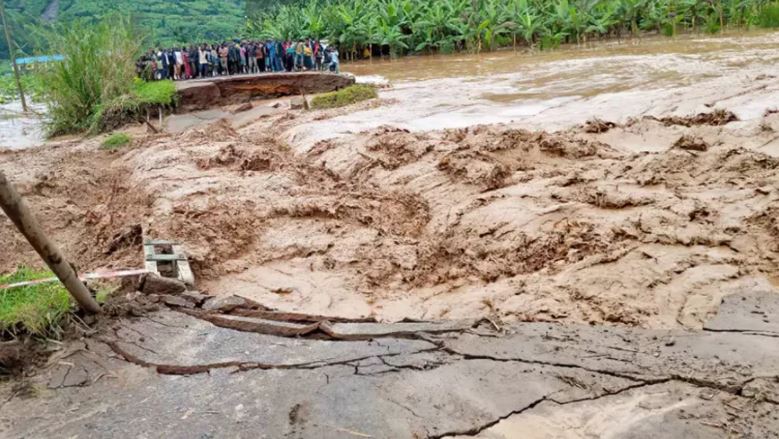
According to a recent report published by the UN-Intergovernmental Panel on Climate Change (IPCC), Rwanda could experience more extreme weather patterns especially flooding and landslides in the next one or two decades as global warming keeps increasing.
The report highlights that global warming of 1.5 degrees Celsius or 2 degrees Celsius will be exceeded during the 21st century unless there are deep reductions in carbon dioxide and other greenhouse gas emissions in the coming decades.
Rwanda’s 10-year climate agenda features a reduction of greenhouse gas emissions equivalent to 4.6 million tonnes of carbon dioxide by 2030.
theinspirerpublications@gmail.com


Leave a Reply