
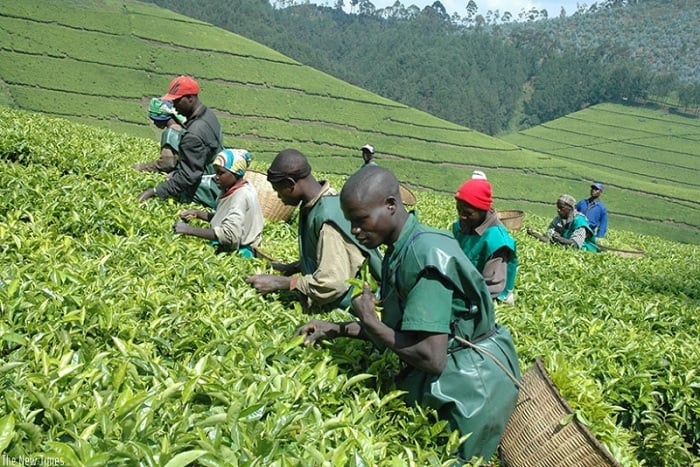
Tea production doubles, boosting national economy
By Placide Ngirinshuti.
Tea production increased from 22,183 to 38,000 tons since 2013 to 2022, the increase that is accounted to 10 percent according to the information from National Agricultural Export Board (NAEB) in 10 years ago.
The information was revealed on May 21, 2023, the International Tea Day that brought together various actors in coffee production and value chain development.
Sandrine Urujeni, Chief Operations Officer at NAEB, said that the international tea day is meaningful for tea producers to embark on professionalism and recalls for their role on tea value chain since 1952 of its establishment.
“We are happy that tea transformed lives for farmers, now they are not yet struggling with poverty issues, especially in Gikongoro-Nyamagabe, we are happy that the tea revenue increased to 90 percent, where it increased from $56 million in 2013 to $106million currently,”

Since 2019, the UN established the International Day of Tea and started to be celebrated since 2020 during the covid-19 pandemic.
Rwanda mountain tea and Kitabi tea factory supported the initiatives and other Rwanda tea associations where farmers, factories and cooperatives come together.
“Today we count 51,196 tea farmers including 67 percent men and over 32 percent women, overall, we have 21 cooperatives of tea farmers,” Urujeni said.
Currently, at least 18 tea factories are running by self-entrepreneurs in the private sector.
Rebbeca Jeanette Nyinawumuntu, who represents Open Street Map Rwanda, says that they are doing whatever to promote Rwanda tea.
“Because when you go to international websites like Wikipedia and you find that there is no story about Rwanda about tea, it is very surprising, it means that maybe the writers don’t care or don’t know about it. So, what we are doing is to put it on social media, which is read by the whole world, not a single newspaper from Rwanda or abroad.” She said.

Nyinawumuntu said that Rwanda chose to promote Rwanda tea as the top national agricultural brand, as they cater for biodiversity, pollution and climate change.
“We decided to promote Rwanda tea because it is one of the crops that are financially developed in Rwanda and that brand Rwanda as a country, as youth who came together for this initiative, we found that tea is one of the Rwanda’s priorities in income-generating farm products,” she said.
She added that Rwanda has played a significant role in biodiversity conservation and mitigating the impacts of climate change.
Dr. Martin Luther Mawo, Director of Sales and Marketing at Rwanda mountain tea said that they used the Mombasa tea production association to ensure the quality of Rwandan tea in Africa, noting that the reason to work with those people to ensure they have skills on digitalization on the process of coffee marketing at the global level.
“One of the expectation’s is visibility, young people will have knowledge, it is very important for us to write about our own stories and get practices o our fields,”
Tea farming started in Rwanda since 1952, with 51,196 workers now, of which more than 67% are men, and 32% women.

theinspirerpublications@gmail.com




Leave a Reply