
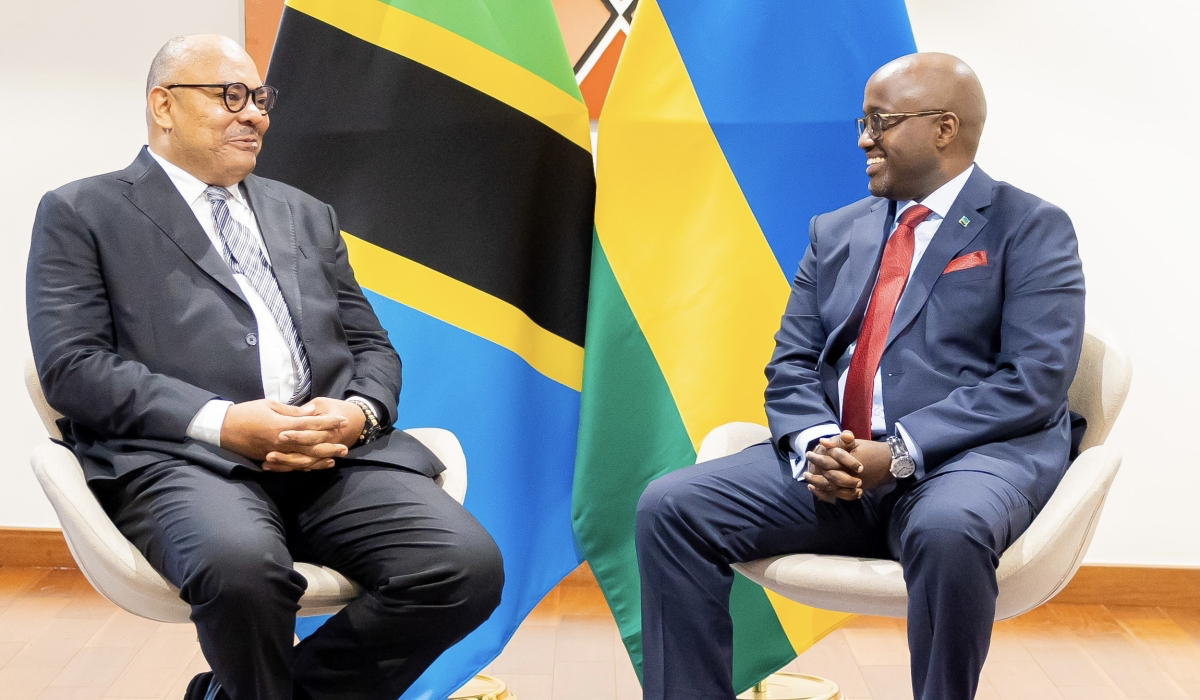
Tanzania and Rwanda Commit to Deeper Ties with Focus on Transport, Language, and Trade
By The Inspirer Staff.
Kigali, July 26, 2025— Tanzania and Rwanda have reaffirmed their shared commitment to strengthening bilateral ties through enhanced regional integration, with key developments in air connectivity, railway infrastructure, and cultural cooperation taking center stage.
The renewed cooperation was announced during a ministerial session of the 16th Joint Permanent Commission (JPC) between the two countries, held in Kigali on Saturday. Mahmoud Thabit Kombo, Tanzania’s Minister of Foreign Affairs and East African Cooperation, outlined the range of ongoing and planned initiatives alongside his Rwandan counterpart, Olivier Nduhungirehe.
Strengthening Air Connectivity
Kombo lauded the robust air links between the two countries, highlighting that Rwanda—alongside Kenya—currently maintains the highest number of commercial flights to and from Tanzania among its neighbors. RwandAir operates daily flights to various Tanzanian cities, a development Kombo described as a strong foundation for bilateral cooperation.
“That is very encouraging because connectivity is very important in any kind of relationship. So, cooperation on air services is ongoing and we are expecting to do more,” he said.
He noted that 90 percent of Tanzania’s delegation to the JPC, including himself, had traveled to Kigali aboard RwandAir, praising the airline’s service delivery and efficiency.
Looking ahead, Tanzania is encouraging the revival of Air Tanzania’s flights to Kigali. The national carrier previously operated routes to Rwanda’s capital, but service was halted due to unspecified reasons. Kombo revealed that discussions are underway to resume passenger flights and introduce cargo services, tapping into Air Tanzania’s freight capabilities to bolster trade between the two nations.
Advancing the Railway Agenda
Beyond the skies, the two governments are also working to revive the long-anticipated Isaka-Kigali standard gauge railway (SGR), a transformative infrastructure project intended to facilitate smoother, more efficient transport of goods and people across borders.
“The technical issues, such as the feasibility study and route planning, are under consideration at the ministerial level in Tanzania,” Kombo stated.
Once operational, the railway is expected to enhance regional trade, reduce transit times, and support Rwanda’s ambition to become a logistics and service hub in East Africa.
Promoting Kiswahili as a Shared Language
In a show of cultural solidarity, Kombo also commended Rwanda’s adoption of Kiswahili as one of its four official languages—alongside Kinyarwanda, English, and French. Tanzania, known as the custodian of Kiswahili, expressed readiness to support Rwanda in deepening the use of the language across government institutions and schools.
“We want to provide more facilitation, including books and teachers,” Kombo said, adding that Kiswahili, now spoken by over 200 million people globally, has become the most widely used language in East and Central Africa.
Tanzania hosts the headquarters for Kiswahili promotion under regional blocs such as the East African Community and SADC, and also globally through UNESCO.
Broadening Bilateral Cooperation
Beyond infrastructure and culture, the JPC meeting underscored Tanzania and Rwanda’s commitment to deeper collaboration in a wide array of sectors, including trade, investment, agriculture, energy, tourism, ICT, health, and defense.
“I am pleased to note that our two countries agree to strengthen and intensify cooperation on political and diplomatic consultation,” Kombo added.
The session in Kigali marks another step forward in the two countries’ shared vision for economic integration, sustainable development, and regional stability.




Leave a Reply