
Refugees and host communities get toolkits to enable job creation and business growth
By Michel Nkurunziza.
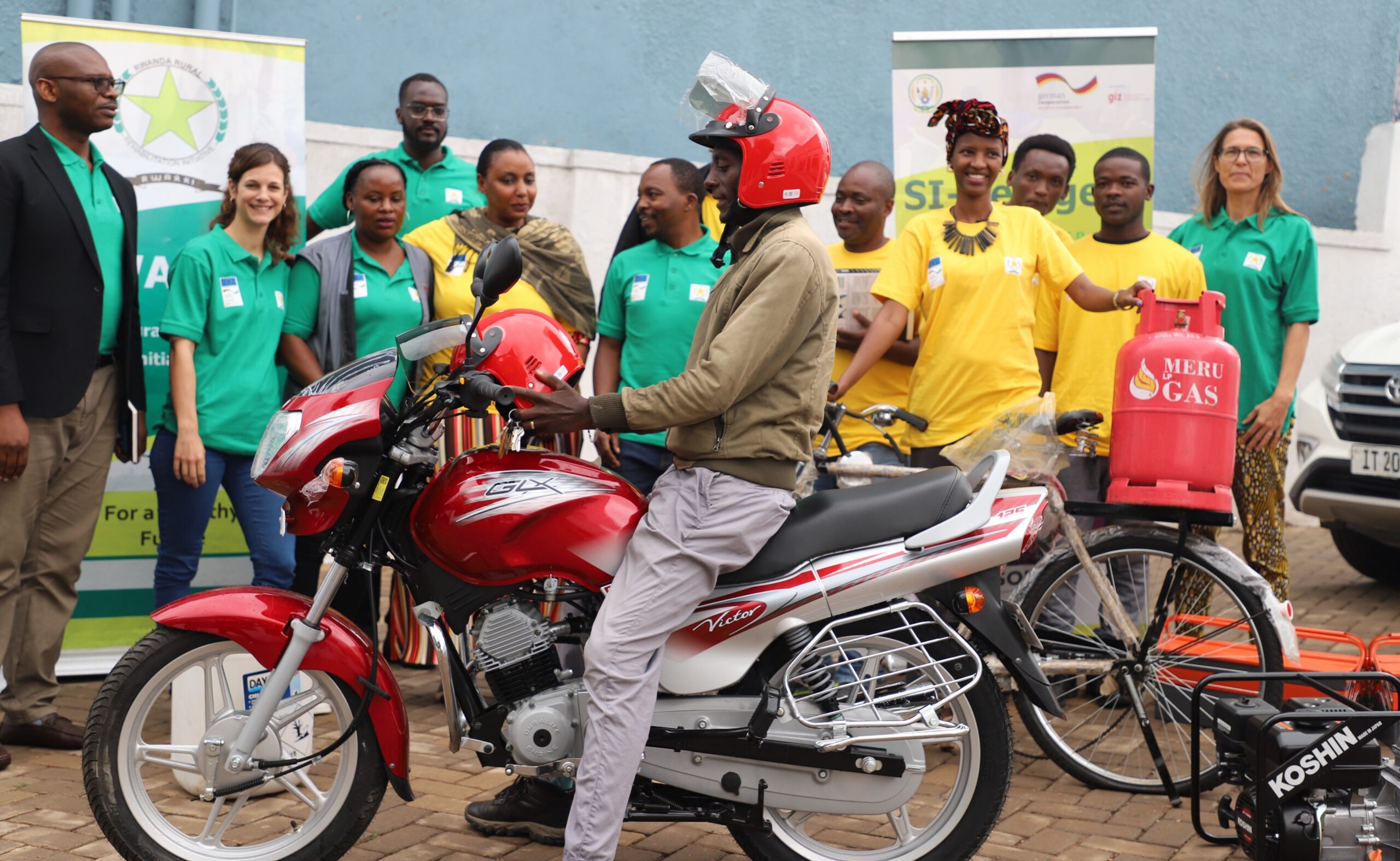
At least 301 businesses comprising TVET graduates and existing enterprises from different refugee camps across the country as well as host communities received toolkits and equipment to enable job creation and business growth as a way of fostering self-reliance.
The support was provided through ECOREF, a project funded by the European Union and the German Federal Ministry for Economic Cooperation and Development (BMZ) and implemented by The Deutsche Gesellschaft für Internationale Zusammenarbeit (GIZ) in partnership with Rwanda Rural Rehabilitation Initiative (RWARRI).
The recent handover ceremony of tool kits and equipment to urban refugees in the City of Kigali was graced by Richard Gasana on behalf of the Ministry in Charge of Emergency Management (MINEMA).
He said the support is in line with the government policy to ensure self-reliance among refugees.
“Refugees rely on aid, but aid will not always be available. They applied for the toolkits and we hope that as they create jobs, and expand their businesses, they can also employ other refugees. We urge them to utilize the funds well,” he said.
Generally, the project is operating in the districts of Kirehe benefiting refugees from Mahama camp and host communities, Gisagara benefitting refugees from Mugombwa and host communities, Nyamagabe benefiting those from Kigeme refugee camp and host communities, Kigali and Huye cities benefit urban refugees.

The toolkit recipients, youth who graduated from TVET trainings and existing entrepreneurs supported by ECOREF, were selected through a competitive application process.
“Through the ECOREF project, a lot has been done, and RWARRRI has three main responsibilities”, the Executive Director of RWARRI, Belange Uwizeye explained. “One is to help those who benefitted from professional upgrading through TVET to form saving and loan groups.
We had to look at what we could do to help them create jobs. We focused on providing toolkits/equipment as key job creation and business development enablers. Those in need of the tool kits were so many and therefore, we selected them through an application process,” he said.
The beneficiaries, to be selected, had to present a viable business or project that is fundable.
“As all recipients are members of a saving group, they had also to prove that they are willing to contribute five percent of the tool kits/equipment value into their joint saving group account to ensure they have ownership before funding them. The host communities were also supported,” he explained.
In addition to TVET graduates, at least 20 businesses were supported.

“Of these, 13 businesses are based in urban areas, namely Huye and Kigali cities,” he said.
So far, over Rwf130 million in toolkits and equipment have been provided to 301 beneficiaries (refugees and host communities).
“Some are individuals while others run businesses as a group. They were trained in financial literacy. Rwanda and its partners have a target to help refugees become self-reliant because aid to refugees has been declining. TVET and doing business is a key enabler for self-reliance among them and this is what we expect as an outcome,” he explained.
Nanda Ritsma, the Project Manager of ECOREF at GIZ Rwanda, said that the project aims to ensure economic inclusion for refugees living in Rwanda and host communities.

“The project started in 2018, but we started supporting the first cohort of 800 youth in TVET in 2019-2020. We continued in 2022 with the 2nd cohort of 600 people. The graduates are trained in different skills. They received tool kits to support them in finding employment or starting their businesses,” she said.
She said the project has also worked with 250 existing entrepreneurs to benefit from entrepreneurship training.
Through the application, some get equipment to boost their businesses.
To get support, the beneficiaries must show how they plan to generate income or create jobs using the tool kits and equipment, have viable businesses or business plans and be ready to give jobs to other refugees.

“The project is mainly benefitting Burundian and Congolese refugees. We want them to become self-reliant after skills upgrading and through saving groups. Ultimately, the mission is that the beneficiaries become self-reliant and that they move out of poverty.
We are completing TVET training for 1800 youths-50 percent from refugee communities and 50 percent from host communities. We are also looking at 250 businesses to grow their businesses,” she said.
Refugees welcome the support.
Jacqueline Muhimpundu, a Burundian refugee living in Kigali, is among the ECOREF beneficiaries who produce liquid soap.
“I have been in Rwanda for eight years now. I have a company called DETEX Enterprises Ltd producing liquid soap. I commend the support to expand my stocks of needed raw materials after being trained. I had a stock that can serve my production for one month and with new equipment, the stock can serve me for three months,” she said.
She noted that she was only supplying to 10 big clients and with new support, she can serve about 40
“I was employing six people and now I can hire two more people. The income, I expect, will also help to have a stock that can serve me for six months,” she said.
Renovat Nitunga, a Burundian refugee in Kigali, has an agribusiness company called “Green and Fresh Foods.”

“We are focusing on the value chain of avocado and pepper but we are still growing only pepper. We also got a license to export. So I got support of 100 crates to reduce post-harvest losses along the value chain,” he said.
The entrepreneur also received precision measuring scales and irrigation equipment.
“I am growing vegetables on three hectares in Kicukiro sector but I target between 10 and 15 hectares in September this year. I was irrigating half of the three hectares one season and irrigated the other 1.5 hectares in another season and now with new equipment I can irrigate all of them at once,” he said.
He said they also have a target to add value and produce finished products from pepper.
“We also want to produce cosmetics from avocado and we will work with avocado farmers,” he said.




Leave a Reply