

Low salaries and staff shortages put pressure on Rwanda’s nurses and midwives
By The Inspirer.
Low salaries that have not kept pace with rising living costs, staff shortages and unpaid overtime are among the challenges affecting nurses and midwives in Rwanda, according to the Rwanda Nurses and Midwives Union (RNMU).
The concerns were raised during a three-day retreat for nursing and midwifery leaders from public hospitals held in Rubavu District from October 21 to 23, 2026.
The meeting aimed to review progress in developing the nursing and midwifery professions, discuss persistent challenges and identify ways to improve healthcare service delivery.
Information presented at the retreat indicated that many midwives in Rwanda earn a monthly salary of Rwf197,000.
Bazatsinda Jean Pierre, head of nursing and midwifery at Nyagatare District Hospital, said the retreat provided an opportunity for leaders from different health facilities to exchange experiences and learn from one another.
“Some challenges have been addressed, but others still require continued efforts to find solutions,” he said.
Bazatsinda identified unpaid overtime as a major concern, explaining that inadequate staffing compared with the number of patients forces nurses and midwives to work beyond their regular hours.
“We still work overtime because our numbers are insufficient compared with the patients who come to us. That overtime is unpaid, and our salaries no longer match the prices of goods and services on the market,” he said.
Ufitiwabo Angelique, head of nursing and midwifery at Kinihira Provincial Hospital, said discussions among nursing and midwifery leaders could help address challenges affecting healthcare services.
She noted that staff shortages force nurses and midwives to work long hours to attend to patients.
Health centre serving more than 41,000 people has only four staff members
Dr André Gitembagara, president of the Rwanda Nurses and Midwives Union, said that although progress had been made in developing the professions, several challenges still required coordinated action by relevant institutions.
He said the retreat focused on reviewing achievements and identifying ways to strengthen the professions and improve the quality of healthcare.
Gitembagara said nurses’ and midwives’ salaries had remained unchanged for a long time despite rising prices of goods and services.
He also highlighted severe staffing shortages at some health centres, where a small number of workers must serve large populations, leaving them with little opportunity to rest.
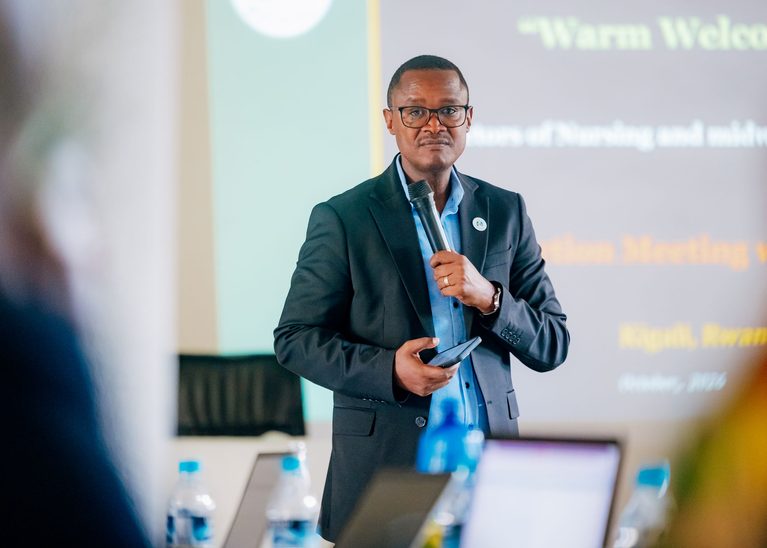
“We discussed several challenges affecting our profession, including salaries for nurses and midwives that no longer reflect the current cost of living and have not been revised for a long time,” he said.
He cited a health centre in Nyagatare District that serves more than 41,000 people but has only four staff members: three healthcare workers and the facility’s manager.
“This means none of them can really go home. It is as though they all live at the health centre,” he said.
Gitembagara said the union would continue engaging the government and other relevant institutions to seek lasting solutions to challenges affecting nurses’ and midwives’ working conditions and welfare.
Figures cited in the report show that in the 2016/2017 financial year, one nurse served an average of 1,094 people. By 2021, the figure had risen to 1,198 people per nurse.
A target had been set to achieve a ratio of one nurse for every 800 people by 2024.
Nursing in Rwanda has undergone significant development since the 1994 Genocide against the Tutsi. Whereas nursing education was previously offered at A2 level, aspiring nurses can now pursue studies up to a PhD.





Leave a Reply