
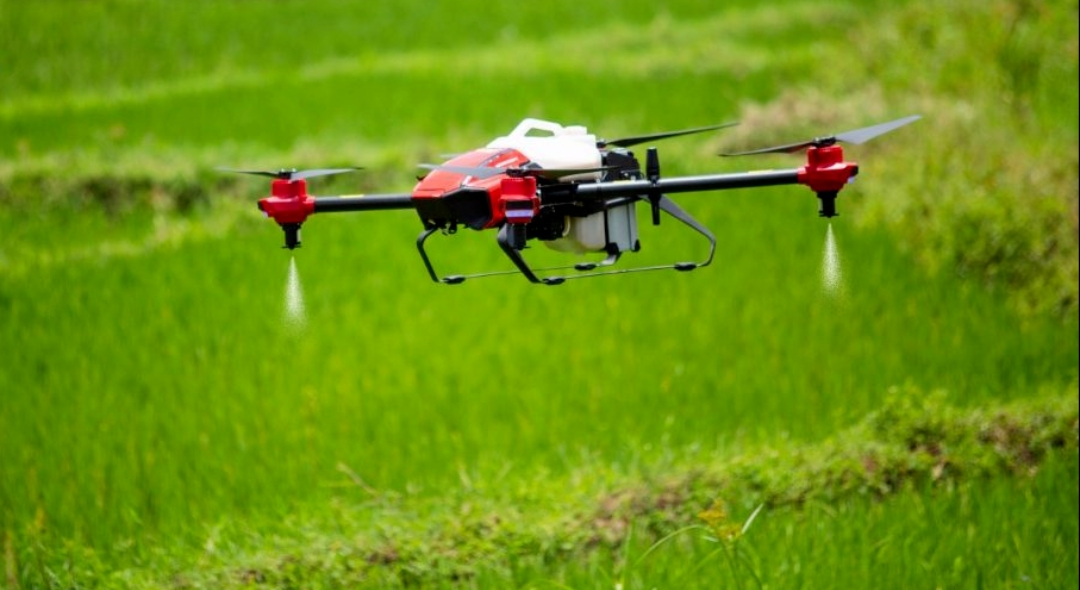
Insecticide-spraying Drones are helping to control Malaria in Rwanda
By Elias HAKIZIMANA.
Eight months ago, Rwanda launched a major fight against malaria using drones to wipe out populations of mosquito larvae, preventing them from becoming adults and infecting people with malaria.
Rwanda is in need of innovative measures to control the disease as the country has seen an increase in malaria cases in recent years, with 3.6 million cases reported in 2019 compared to 2.5 million in 2015, according to World Health Organization figures.
The drone program, led by the government of Rwanda in partnership with local drone technology company Charis Unmanned Aerial Solutions (Charis UAS), hopes to rid communities of malaria-spreading mosquitoes and initial data is showing promise, with fewer malaria cases being reported in target areas.
No big challenges have been encountered yet and preliminary results are already showing a positive impact, said Mr. Eric Rutayisire MUZIGA, the Chief Executive Officer of Charis UAS.
The ambitious initiative launched on 10 March in Kigali City, GASABO District, Rusororo Sector, Mbandazi cell, an area made up of mostly swamps and rice plantations, which are well-known breeding sites for mosquitoes. It will run in this region until February 2021, after which the drones will target 15 districts in the eastern and southern provinces of Rwanda, considered to be endemic zones for malaria due to climate, altitude, and malaria prevalence.
Both provinces accounted for 79 percent of the malaria burden in 2017, according to data from the Malaria and Other Parasitic Diseases Division’s (MOPDD) health management information system (HMIS).
“Charis UAS firstly map mosquito breeding sites using drones and once mosquitoes breeding sites are mapped, the areas are sprayed with larvicide,” said Mr Muziga. “The spraying done with drones is more effective, very precise, in terms of location to spray, quantity to be sprayed and time,” he said.
Each drone is fitted with a 12-litre tank of insecticide that specifically targets mosquito larvae and follows a pre-mapped route to spray vast areas of land that are known breeding sites for mosquitoes, such as swamps or wetlands. They have the capacity to fly for 15 minutes on a single battery and spray an area of one hectare in that time.
Dr. NGAMIJE Daniel, the Minister of Health during the launch of this program told KT press that the drone technology would cut costs in logistics, human error and minimize the use of chemicals. It takes the battle inside mosquito breeding areas instead of waiting for them to grow and infect people, he said.
A POSITIVE IMPACT ALREADY
The program is still in its early stages, meaning data are still being collected for analysis at the end of the pilot in February, but initial findings are positive.
“Monitoring data for larval and adult stages are collected every two weeks as well as the spraying of mapped water bodies and malaria cases are reported by community health workers and collected on monthly basis,” said Dr. Emmanuel HAKIZIMANA, Director of vector control at Rwanda Biomedical Center.
He explained that this checks the effectiveness of the insecticide and confirms if many mosquitoes remain in the area.
Dr. Hakizimana believes the drones are greatly contributing to the fight against malaria based on anecdotal data reported by community health workers.
Mrs. BARAYAVUGA Benita, a community health worker in Cyeru village, located near the Rugende and Kabuga swamps in Rusororo sector, and mother of three children says malaria carrying mosquitoes are biting fewer people in the area.
“As a healthy community worker in the village of Cyeru, I used to receive at least 80 people tested malaria positive a month before spraying such insecticide, but currently I receive about 10,” she said.
Further impact has been seen across Rusororo sector, according to Mrs. UWIZEYE Gloriose, head of Solace Medical Clinic in the sector’s Kabuga cell, Gasabo District, which serves a population of over 50,000. Malaria cases reported in this sector have come down this year, from 22,834 malaria infections in 2019 to 8,739 so far in 2020, she said.
“That activity greatly reduced malaria incidence by more than 60 % compared to the numbers we used to report before spraying the anti-malaria pesticide using drones,” said Mrs Uwizeye.
This is despite already having in place other strategies like using bed nets and habitat removal, she said.
The initiative is also showing results at the district level. For example, the target to reduce malaria infections and deaths in Gasabo district in 2019-2020 was 10%, but there has already been a 25% reduction in deaths and a 64.75% decline in infections, according to Mr. RUTARINDWA Alphonse, the Director of health in GASABO District.
Gasabo District reported 164,030 malaria cases in 2019 and 20 deaths while in 2020, there have been 57,818 cases and 5 deaths as of November 18th, 2020 according to the 2015-2020 Gasabo District Malaria report.
“There is no doubt in saying that the activity is greatly contributing to reduce malaria,” said Mr. Rutarindwa.
Overcoming challenges
Some groups have expressed concern around the environmental impact of spraying insecticides in this way, but Mr Muziga at Charis believes there will be minimal effect.
He explained that the larvicide being used is a biological product known as Bacillus Thuringiensis Israelensis (BTI), which is approved by the World Health Organization (WHO) and has minimal effects on the environment or other animals.
The main challenge being faced at the moment is a limited number of drones. Just two drones are in use, hence why the program is still spraying in Gasabo District in this pilot phase. This phase has already cost over 60 million Rwandan francs ($63,070).
However, Dr. Hakizimana is advocating for budget to purchase more drones, train more pilots, and the scale-up of interventions in other areas that are considered high endemic zones for malaria.
Talking to KT press during the launch of this program, the Health Minister Dr. Ngamije said that the project hopes to cut malaria infections by 90% over the next nine years.
It’s hoped that by targeting mosquito larvae, the drone program will build on work being done by existing malaria interventions that target adult mosquitoes.
Cases of malaria decreased from 4.2 million in 2018 to 3.6 million in 2019, while deaths fell from 341 in 2018 to 224 in 2019, according to the WHO’s 2020 World Malaria report.
“Existing interventions such as bed nets and indoor residual spraying, are indoor interventions targeting only adult stages of mosquitoes,” said vector control expert Hakizimana. “The combination of control of both larval (young) and adult stage of malaria vectors may boost the achievements towards malaria elimination.”
This story was produced by The Inspirer. It was written as part of Reporting Malaria, a media skills development programme run by the Thomson Reuters Foundation. The content is the sole responsibility of the author and the publisher.




Leave a Reply