
Rwanda integrates ‘Unitree G1 EDU U6’ humanoid robot into education
By The Inspirer.
Artificial intelligence (AI) projects continue to expand worldwide, and Rwanda is increasingly embracing them as a key driver of national productivity.
In April 2023, the Cabinet approved a five-year National AI Policy to accelerate AI adoption across various sectors.
At the time, analyses showed that $76.5 million in investment would be required to fully integrate AI, maximizing its contribution to Rwanda’s economic growth.
One key area is the use of robots in practical applications—a trend common in developed countries, where over 4.6 million robots are currently in operation globally.
In Rwanda, robots are now being deployed in several sectors, including education, where they assist students in learning and completing school-related tasks.
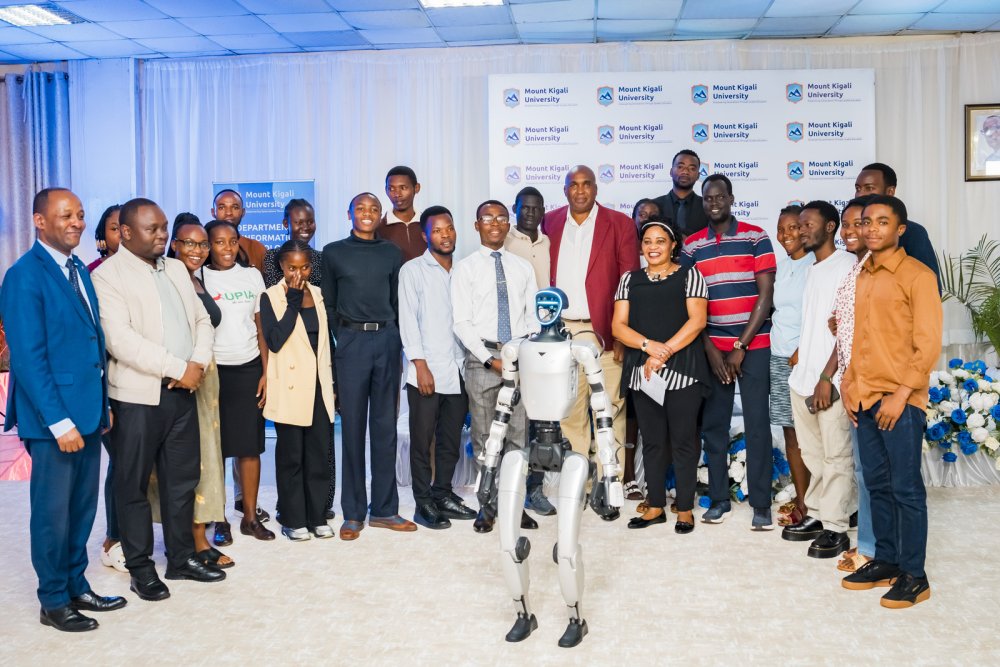
The ‘Unitree G1 EDU U6 Robotic Humanoid’ is currently used at Mount Kigali University, particularly by students in technology programs and courses requiring AI applications.
Designed for research and AI education, the Unitree G1 EDU U6 helps students understand robotic functions and AI operations.
Manufactured in China by Hangzhou Yushu Technology under Unitree Robotics, the robot is humanoid in design.
The ‘EDU’ designation indicates its educational and research purpose, and the robot can be customized according to user requirements.
The U6 classification reflects its advanced capabilities, allowing it to mimic human movements, including fully articulated hands—a feature uncommon in most robots.
It can walk, stand upright, manipulate objects, observe its environment, navigate, dance, and perform other human-like actions.
Its mobility is supported by triple-jointed degrees of freedom (DOF) in its limbs and seven-jointed arms, providing human-like flexibility and movement.
Its knees exert up to 120 N·m, enabling fast, agile movement, rotation, and sport-like maneuvers.
Each hand has five fingers equipped with sensors to detect weight, texture, and temperature of objects.
The robot’s eyes include cameras and 3D LiDAR sensors (Light Detection and Ranging), allowing accurate perception of distant objects.
It also has microphones and speakers, enabling two-way communication for interactive learning with humans.
The robot operates like a computer, powered by an 8-core CPU for AI processing, making it suitable for teaching any subject and understanding multiple languages.
Standing 1.32 meters tall and weighing 35 kilograms, it can be disassembled and reassembled for easy transport. It runs on two batteries, each lasting at least two hours.
The Unitree G1 EDU U6 costs between $13,500 and $16,000 (over 23.3 million Rwandan Francs) and is primarily used in universities, tech laboratories, and emerging AI-focused institutions.
Prof. Simon Gicharu, Chairperson of Mount Kigali University’s Board, said the robot will significantly enhance Rwanda’s education system.
“Introducing this technology to Rwanda is a major step for national education. Students should maximize its use so that, in the future, Rwanda becomes recognized as a hub for technological expertise,” he said.
Student Ivan Karangwa Nshuti described the robot as transformative for daily learning.
“Previously, we focused on theory, but now we can code and test the robot’s functions. We don’t know everything yet, but we are confident it will share knowledge and help us build our own robots here,” he said.



Leave a Reply