
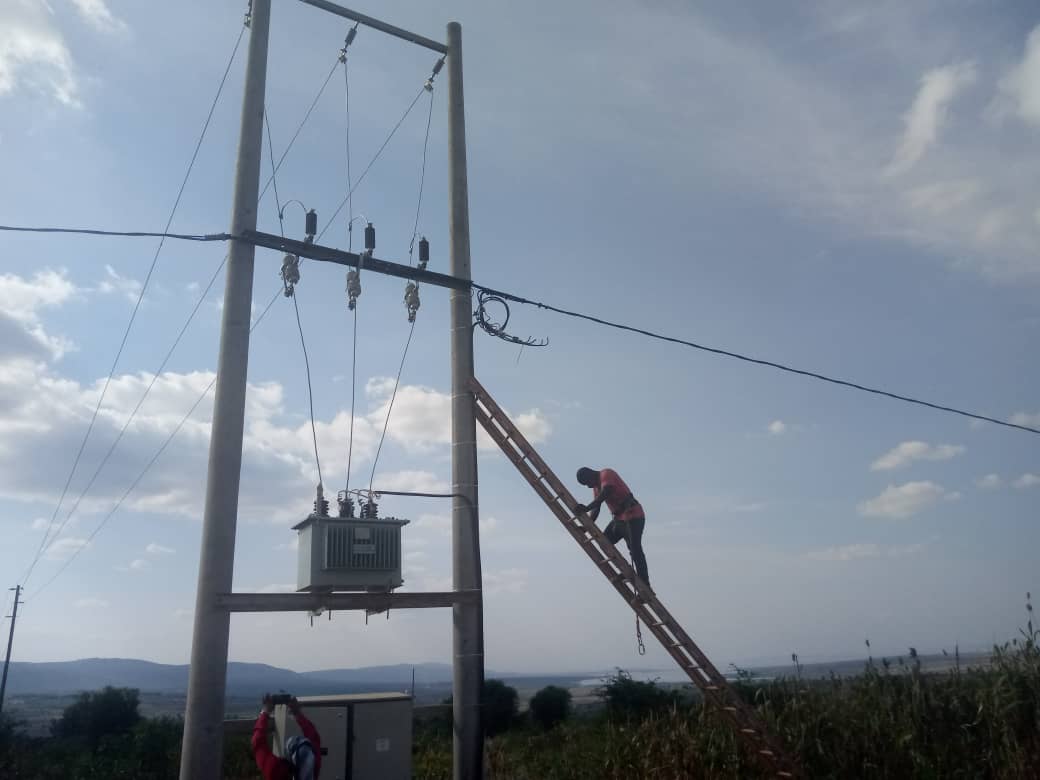
74% of households have electricity, few months remain to meet universal access
By Elias HAKIZIMANA.
At least 74.4 percent of households in Rwanda are connected to electricity countrywide from 61 percent last year as a few months remain to achieve universal access to electricity for all Rwandans by 2024.
Of the 74.4 percent connected households, 2.5 million households that are equivalent to 54 percent are connected to on-grid energy while 1.8 million, equivalent to 24 percent are connected to off-grid electricity, and 20 percent are connected to other plants.
According to Rwanda Energy Group (REG), there is good progress towards achieving this target, which is aligned with the National Strategy for Transformation (NST1).
Some of the parameters to prove positive progress include the reduction of electricity cuts/breakouts that reduced from 40 to 19 hours per year.
The challenge that could derail efforts to meet 100 percent universal access to electricity by 2024 is limited financial capacity according to Armand Zingiro, Chief Executive Officer of Rwanda Energy Group (REG).

He said this body still needs $600 million out of the $1.2 billion that was needed to fill the gap.
Speaking to the media on October 24, 2023, in a press conference, Zingiro explained that positive progress is being made to meet the target within the remaining two months.
“We are in good progress indeed, recently, since last year, we connected 230,000 households, and we have reduced factories that use diesel fuel to 57 percent since June 2023; we also have capacity at REG level plus the contribution of other partners to be able to achieve nearly the universal access in the remaining period,”Zingiro said.
Fines against infrastructure theft
Zingiro said that the energy body has so far arrested over 800 culprits who were found stealing and selling electricity infrastructures including metals, wires and transformers since the beginning of the year 2023.

He also said that the country has attained an electricity generation of 333 Megawatts, with a demand of 205 Megawatts currently.
The country also has one peat factory that generates 70 Megawatts a day during the sunny season.
“The country tries to support this investor, who gives us 20 to 25 Megawatts. Next year, they will be giving us 35 Megawatts,” Zingiro noted.
The National Electrification Plan (NEP) plans to give electricity to whoever lives in the grid zone.
Other best practices to streamline and fast-track the progress are the reduction of electricity prices that were established in 2020, and the replacement of the old infrastructures including wires and poles at outstanding standards among others.
The country has built 1,150 kilometers of national grid to connect nearby citizens.
Rwanda Energy Group has also initiated a three-year Rwf30 billion project in 2022 to tackle the issues of connectivity.
REG targets to exceed the Energy Sector Strategic Plan from 556 to 700 Megawatts. The body also has a Rusumo hydro powerplant project that will generate 80 megawatts to be shared between Rwanda, Tanzania, and Burundi. The pilot project estimates the current 27 Megawatts.

Electricity coverage by supply system categories
According to the figures from REG, 31 percent of the electricity used in the country is sourced from water, 24 percent from peat, 16 percent from methane gas 13 percent from other factories, and 3 percent from solar energy.
“In recent years, we have also completed 600 kilometers project to connect the roads countrywide, in the Eastern, Western, Southern, and Northern Provinces,” says, Armand Zindiro, REG Chief Executive Officer.
In March 2021, around 52.8% of households in Rwanda had had access to electricity with 38.5% of households connected to the national grid while 14.3% were using off-grid solutions.
theinspirerpublications@gmail.com


Leave a Reply