

Rwanda: Special campaign to streamline meat value chain kicks off
By Elias Hakizimana.
The Government of Rwanda has started a campaign to raise awareness of meat value chain with players and all stakeholders’ involvement to ensure compliance with safety and quality standards of meat from the farm, butcheries, transportation to the market for the last consumer.
Dubbed ‘Safe and quality meat for all campaign’, it will emphasize on regulatory requirements with an emphasis on meat traceability and hygiene practices in order to increase competitiveness while unlocking new business opportunities on both domestic and regional markets.
The National Meat safety and quality Campaign will also provide a unique opportunity for industry operators and stakeholders to reflect on concrete strategies and needed infrastructures to increase the quality of meat as a key to enter into new markets while also raising awareness of consumers’ rights to safe and quality meat processed and sold in hygienic conditions.

Speaking during a press conference organized by Rwanda Inspectorate, Competition and Consumer Protection Authority (RICA), Beatrice Uwumukiza, Director General of RICA said the campaign targets to bridge the meat imports and exports gaps by ensuring effective production of safe and quality meat to be sold at both local and international markets.
“Rwanda’s meat products are exported to the regional markets mainly in DRC, Goma and Bukavu. We want to ensure quality meat starting from the places of livestock farming, to the transport of livestock, to the butcheries and slaughtering houses up to the last consumer at the markets.” Uwumukiza said.
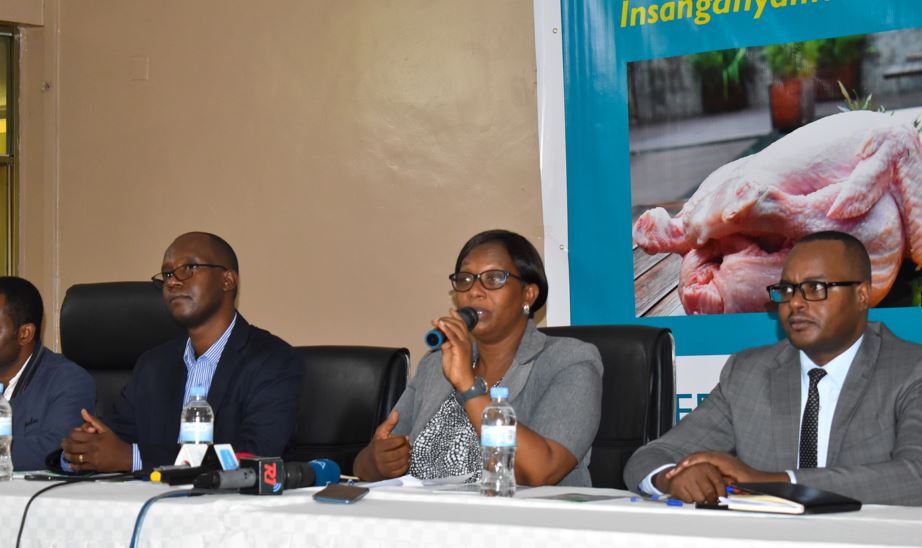
The campaign is a joint effort implemented by RICA in partnership with different institutions including the AfDB-funded Meat Competitiveness Project under MINICOM/ SPIU, The USAID Feed the Future funded Orora Wihaze Activity, PRISM/ ENABEL and PRISM/IFAD under MINAGRI in order to streamline the meat value chain towards the production and trade of safe and quality meat.
The Rwanda Inspectorate, Competition and Consumer Protection Authority (RICA) was established by the Law Nº 31/2017 of 25/07/2017 to carry out inspection of quality and standards conformity and promote healthy competition in the economy by prohibiting unfair business practices as well ensuring consumers protection.
Meat makes an important part of inspected food products and the success of safety and quality requires fair practices in this chain.
Meat value chain has been identified as a key sector to drive the 4th Plan for Strategic Transformation of Agriculture (PSTA4) with a target of 128,091 MT and the demand is expected to increase due to change in dietary patterns as a result of per capita income growth.

Rwanda meat value chain trade competitiveness targets to enhance the competitiveness of the meat value chain in Rwanda through the strengthening of the institutional and regulatory framework in the meat sector; to enhance the capacity of private sector actors in the value chain; and to increase Cross-border Trade (CBT) and exports through market linkage activities.
Uwumukiza said that through this campaign, citizens who are the consumers of meat will be also sensitized about their rights to safe and quality diets.
“We continue to encourage consumers to ask meat traders where the animal has been slaughtered from and if they have authorization papers of safety inspection by concerned authorities.” She said.
Slaughter houses and Butchery Inspection
“There are stringent measures we take on the slaughter houses and butcheries that produce meat suspected to cause hazards on consumers’ health. We ban trade of these meat as we cannot accept that Rwandans eat sub-standards and unsafe meat. We tell the butchery owner that the meats are not safe for human consumption and they are taken to waste and we tell the owner to first comply with some issues.” Uwumukiza explained adding that RICA has a plan to register and publish the list of all authorized slaughter houses and butcheries to sell safe and quality meat countrywide.

Gaspard Simbarikure, Director of Food Inspection Unit at RICA said that authorization and registration of private meat inspectors is a solution to the limited number of RICA whereby they will manage to reach out all the butcheries and slaughter houses in the country.
“In a bid to find a solution to that problem, we decided to work with private meat inspectors. These are current professionals registered in Rwanda Veterinary Council (RCVD), must be honest with integrity and with professional ethical standards.” He said.
Since January 2022, RICA started to call private meat inspectors to be registered and qualified ones will be trained on hygiene and safety compliance of safe and quality meat before they start inspection.
Cassien Karangwa, Trade Promotion Director in MINICOM said that there is a program to increase national livestock population in order to have enough quality meat for domestic consumption and increase meat export.

He said that Rwanda exports an estimated quantity of 670,287 tons of meat every year. 255,034 tons of this quantity are locally produced while 415,253 tones are re-exported.
Dr Eugene Niyonzima, Director of Animal Resources Processing and Biotechnology Division at RAB said that meat production in the country has raised progressively since 2012 from 76,830 tons to 185,989 tons in 2022 which is approximately 142 percent total increase.
“This is due to a good number of livestock that has also increased but we have to work hard to reach our target of 215.000 tons of meat by 2024.” Niyonzima said.
Animal exports
Rwanda also exports live animals including cows, pigs, goats, sheep, rabbits and chickens.
According to a three-year MINICOM report, in 2019, Rwanda exported 4,379,095 kilograms of live animals that increased to 6,079,903 in 2020. In 2021, the total number of exported live animals increased to 8,694,447 kilograms.
theinspirerpublications@gmail.com


Leave a Reply