

Minister Nsengimana calls for bold reforms in higher education
By Elias Hakizimana
As the highly anticipated Times Higher Education (THE) Africa Universities Summit 2025 opened in Kigali yesterday, in Kigali, Rwanda on March 18, 2025, Rwanda’s Minister for Education, Honourable Joseph Nsengimana, emphasized the transformative role of education in Africa’s sustainable development.
He called for urgent reforms in academic training, urging universities to align their curricula with industry needs to tackle graduate unemployment effectively.
The summit brought together over 300 delegates from across the continent and beyond. Under the theme “United Leadership: Harnessing African Higher Education for Sustainable Growth,” the three-day summit is set to shape the future of higher education in Africa through panel discussions, keynote speeches, and networking sessions.
 The summit brought together over 300 delegates from across the continent and beyond.
Minister Nsengimana highlighted that universities must evolve beyond traditional learning institutions to become “engines of innovation, resilience, and economic growth.”
He stressed the importance of strong, inclusive partnerships, both within Africa and globally, to drive sustainable transformation in the education sector.
“African universities must not only receive knowledge but actively contribute to global academia and research,” he stated.
The Minister also underscored that sustainability should be embedded within university programs—not just in environmental concerns but also in economic resilience, social equity, and governance. He urged universities to implement green campus initiatives and community-driven solutions that address Africa’s unique challenges.
The digital revolution and bridging the divide
Nsengimana noted the increasing role of technology in education, highlighting its potential to enhance accessibility and learning outcomes. However, he cautioned that the digital divide remains a significant challenge, particularly for rural and underserved communities.
“We must ensure that new technologies are deployed inclusively so that no one is left behind,” he emphasized.
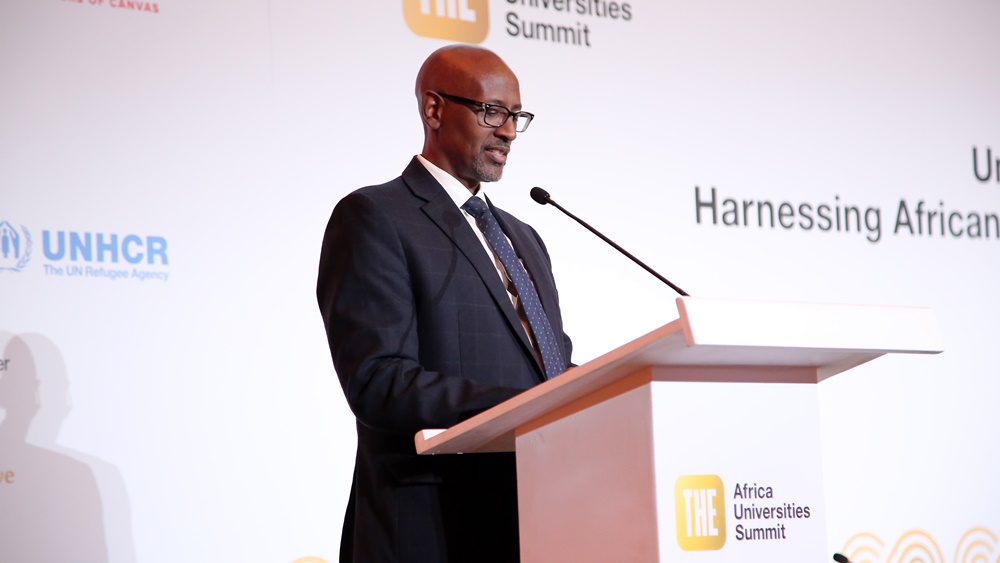 Rwanda’s Minister of Education, Joseph Nsengimana, delivers a keynote address at the Africa Universities Summit 2025 in Kigali, emphasizing the need for digital transformation, sustainability, and stronger academia-industry collaboration to drive Africa’s educational and economic growth.
He called for policies that bridge the gap between urban and rural students, ensuring that digital learning platforms and resources benefit all. “Technology alone is not enough; it must serve the goal of equal opportunity for all,” Nsengimana said.
Addressing graduate unemployment: Aligning academia with industry
A key concern raised during the summit was the high unemployment rates among African graduates. The Minister pointed to a persistent mismatch between academic training and job market needs. He urged universities to collaborate with industries to develop market-relevant programs that equip students with skills aligned with Africa’s economic landscape.
“We must ask ourselves: Are our research priorities aligned with Africa’s economic and social needs? Are we equipping students with the skills that translate into meaningful employment?” Nsengimana challenged attendees.
He stressed that universities must foster innovation, research, and entrepreneurship to drive economic growth and employment opportunities.
 A participant delegate shares insights during a panel discussion at the Africa Universities Summit 2025, highlighting the importance of cross-border collaboration and innovative solutions in higher education.
International cooperation and partnerships as catalysts for change
The summit also highlighted the critical role of international cooperation in transforming Africa’s education sector. Nick Davis, President for the Middle East and Africa at Times Higher Education, echoed the need for strategic partnerships.
“No single institution can address Africa’s education challenges alone. Collaboration across borders, sectors, and disciplines is essential to drive meaningful change,” he said.
A notable highlight was the participation of international delegations, including Saudi Arabia’s Prince Sattam Bin Abdulaziz University, which introduced the “Study in Saudi” program—offering fully funded scholarships for African students in Saudi public universities. Such initiatives, participants agreed, are crucial in fostering global knowledge exchange and empowering African institutions.
 The summit features panel discussions on key topics such as digital transformation in education, sustainable development, university-industry collaboration, and strategies to bridge the skills gap in Africa’s workforce.
A Call to action: reimagining Africa’s higher education
As the summit continues, discussions will focus on policy harmonization, research excellence, digital transformation, and employability.
Nsengimana urged participants to use the platform to formulate actionable solutions that will redefine Africa’s higher education landscape.
“This is not just an academic discussion—it is a call to action. The decisions we make today will define the trajectory of African education for generations to come,” he concluded.
The Africa Universities Summit 2025 is set to continue until March 20, with stakeholders expected to forge partnerships, propose policy recommendations, and outline strategies that will shape the future of higher education in Africa.
theinspirerpublications@gmail.com





Leave a Reply