
AfCFTA training highlights opportunities, challenges in Africa’s push for a single market
By Elias HAKIZIMANA.
Kigali, April 17, 2026. Entrepreneurs and trade stakeholders gathered in Kigali for the Trapca–Rwanda AfCFTA Export Readiness Training for SMEs (Trade in Goods), a capacity-building session aimed at preparing businesses to tap into the African Continental Free Trade Area (AfCFTA), Africa’s flagship trade integration framework under Agenda 2063.
The training, organized to strengthen export readiness among small and medium enterprises, opened with remarks from Adeodata Marie Ange, one of the organisers, who welcomed participants and highlighted the importance of equipping African businesses with practical knowledge to compete in a rapidly integrating continental market.
She highlighted that AfCFTA presents a historic opportunity for African producers to expand beyond domestic borders, but stressed that success depends on understanding trade rules, market requirements, and regional value chains.
Delivering the technical presentation, trade expert Amos Akandwanaho unpacked the structure and ambition of AfCFTA, describing it as a landmark initiative signed in Kigali in 2018 and now binding for 49 African Union member states that have ratified it.
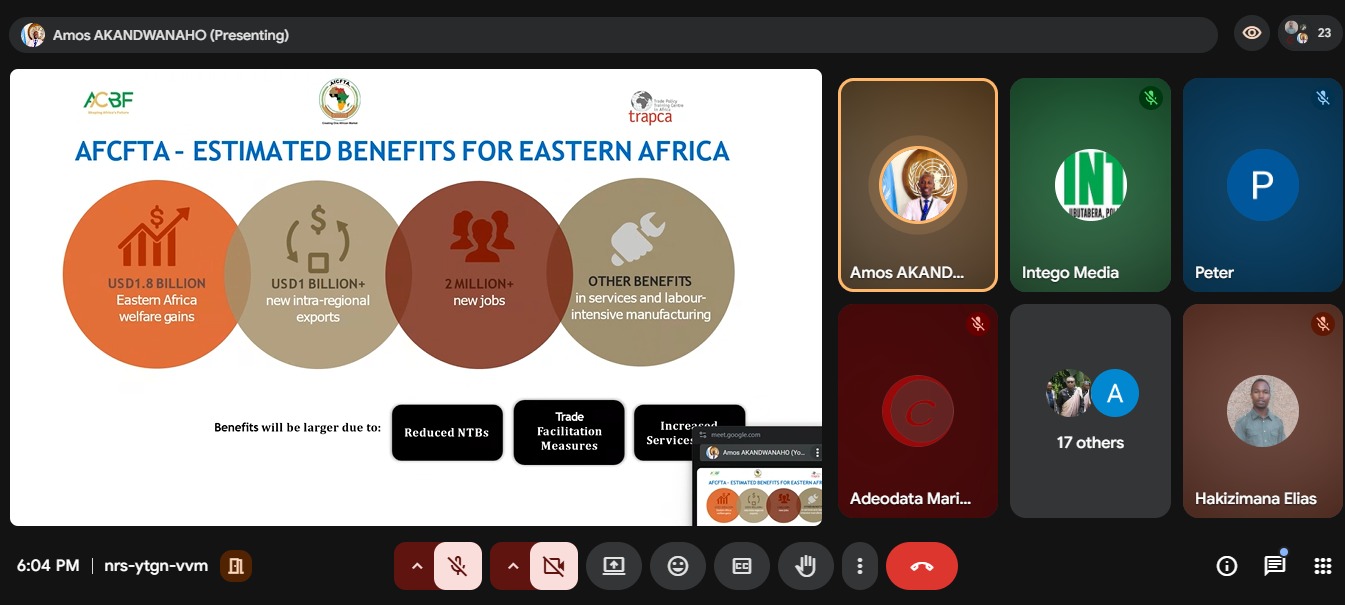
He reminded participants that the agreement aims to create a single African market of more than 1.3 billion people with a combined GDP of about USD 3.4 trillion.
“With a combined GDP of USD 3.4 trillion and 1.3 billion consumers, the AfCFTA is poised to boost Africa’s economies and position the continent as a key player in global trade,” he said.
Akandwanaho explained that AfCFTA seeks to progressively eliminate tariffs and non-tariff barriers, promote free movement of goods and services, and establish a continental dispute settlement mechanism to manage trade-related conflicts among member states.
He also outlined the agreement’s broader institutional framework, including the AU Assembly, Council of Ministers, Senior Trade Officials, and the AfCFTA Secretariat based in Accra, Ghana.
Participants engaged the expert on whether Africa can realistically build a self-sustaining continental market where citizens consume locally produced goods, similar to other large economies.
In response, Akandwanaho said political commitment remains central to the success of integration efforts, noting that existing regional developments such as East Africa’s improved mobility frameworks and passport harmonisation are positive indicators.
“Political will is a fundamental point in every development framework. Without it, implementation becomes difficult,” he said.
He also pointed to ongoing trade recovery within the East African region, citing increasing cross-border trade flows and logistics activity between Rwanda and Uganda, which he said reflects gradual progress in regional integration.
Participants further raised concerns about insecurity, corruption, and recurring trade disruptions across African borders, questioning how AfCFTA can build trust among member states facing such challenges.
Responding, Akandwanaho said the framework includes practical enforcement and dispute resolution tools such as the Non-Tariff Barriers (NTB) reporting system and the AfCFTA dispute settlement mechanism under the African Union.
 The webinar training aimed at equipping SMEs with practical knowledge on AfCFTA trade opportunities, export readiness, and strategies to access and compete in the African continental market.
He added that the African Development Bank has also introduced an Adjustment Fund to support countries that may experience revenue losses during the transition to freer trade.
On how SMEs can benefit from AfCFTA, he highlighted the role of AfCFTA Trading Companies, which help small producers access international markets by aggregating goods from multiple local suppliers.
He cited Rwanda as an example, where such companies support farmers and small producers who lack the capacity to export individually, enabling them to access continental markets collectively.
The training concluded with a shared message that while AfCFTA presents vast economic potential, its success will depend on stronger political cooperation, infrastructure development, and the inclusion of small businesses in cross-border trade systems.
theinspirerpublications@gmail.com





Leave a Reply