
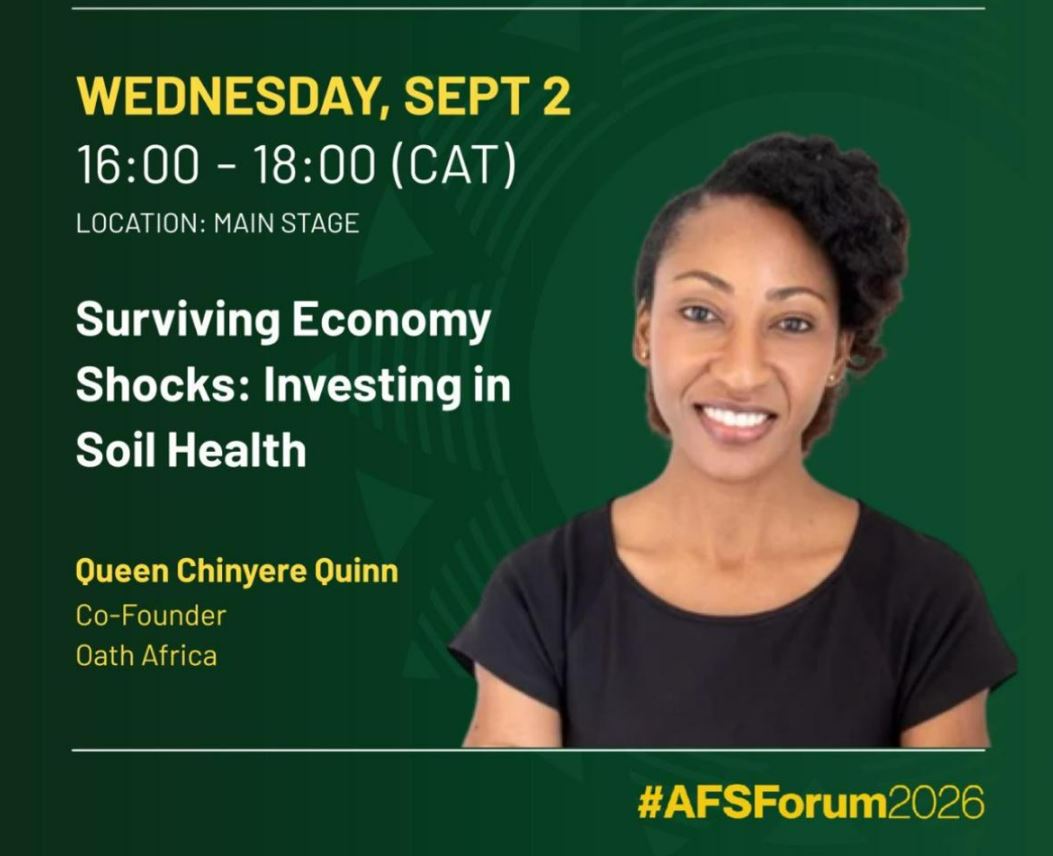
Oath Africa co-founder calls for investment in soil health as Africa confronts agricultural shocks
By Elias HAKIZIMANA.
Africa’s efforts to build resilient food systems will require more investment in soil health, innovation and commercially viable agricultural solutions, experts said during a high-level session at the Africa Food Systems Forum 2026 in Kigali.
The discussion, held under the theme “Sustainable Production: Surviving Economic Shocks: Investing in Soil Health,” brought together policymakers, researchers, development partners, farmers’ organisations and private-sector leaders to examine how Africa can respond to rising input costs, soil degradation and growing pressure on agricultural systems.
More than 65% of Africa’s productive land is degraded, according to the session framing, making soil restoration and sustainable land management increasingly important to the continent’s food security and economic resilience.
Among the private-sector voices was Dr. Queen Chinyere Quinn, Co-founder of Oath Africa and Managing Partner of Kupanda Capital, who highlighted the role of capital in helping soil-health businesses move from early-stage innovation to wider deployment.
Quinn said her experience with Oath Africa has shown the importance of different forms of capital at different stages of a company’s development, particularly for businesses developing biological and microbial solutions for soil health and restoration.
The company is focused on soil-health solutions, including microbial technologies, as part of efforts to address interconnected challenges such as climate change, water insecurity and food insecurity.
Her intervention came as the plenary examined how private investment can support technologies and business models capable of improving soil health while strengthening agricultural productivity.
The wider discussion also highlighted the need to make soil-health investment attractive to farmers. One panelist argued that farmers need stronger incentives to invest in restoring their soils because the benefits often extend beyond a single production season.
H.E. Nardos Bekele-Thomas, CEO of the African Union Development Agency-NEPAD, called for a shift from commitments to implementation, stressing that soil health should be integrated into national and regional investment frameworks.
She identified stronger soil information systems, integrated soil fertility management, climate-resilient finance, private investment in fertiliser and biological inputs, and stronger regional coordination among priorities for action.
The discussion also underlined the role of public-private partnerships in mobilising resources and scaling innovations.
For companies such as Oath Africa, whose work sits at the intersection of soil biology, agricultural innovation and farmer resilience, the conversation highlighted a growing opportunity to connect scientific solutions with investment, policy and practical implementation.
The plenary was held on Wednesday, September 2, as part of the Africa Food Systems Forum 2026 in Kigali.
theinspirerpublications@gmail.com




Leave a Reply