
Floods, respiratory diseases in absence of urban forests in Kigali
By Michel Nkurunziza.
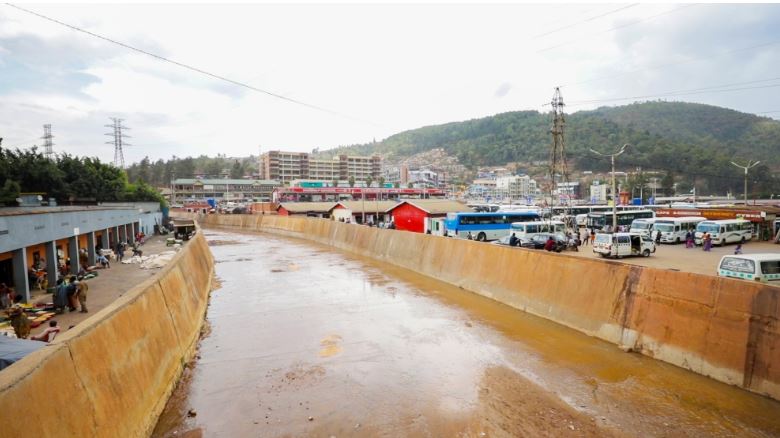
Vianney Ntakiyimana, a shop owner trading electronic equipment at Rwanda’s largest bus terminal, the “Nyabugogo Bus Terminal” located between Nyarugenge and Gasabo District in Kigali city, recalls losing nearly Rwf1 million in a single day due to flooding.

Floods used to hit Nyabugogo bus terminal due to deforestation in the surrounding hills.
The bus terminal connects the city to various regions of the country serving as one stop centre of transportation.
“Flooding damaged all my goods, and I had to dispose of them. They included phones, phone chargers, phone covers, and other merchandise,” he recounted.
Ntakiyimana, who has been in business near the bus terminal for 10 years, has frequently experienced flooding in the area.
“Before the Mpazi drainage system was expanded, the bus terminal would often be submerged, causing extensive damage to goods as the drainage system would overflow. To protect my shop, I even built a cement barrier in front of the door to block floodwaters,” he explained.
According to Ntakiyimana, the runoff water causing the flooding originates from the surrounding hills.

To protect my shop, Ntakiyimana built a cement barrier in front of the door to block floodwaters around Nyabugogo bus terminal
The problem is exacerbated by the lack of rainwater harvesting and retention measures.
Forests that once mitigated flooding have been encroached upon, with houses built in their place, leaving residents in high-risk zones.
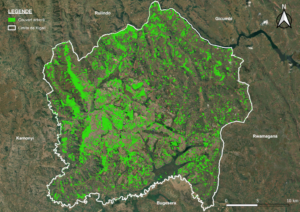
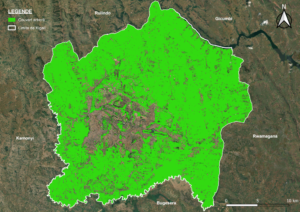
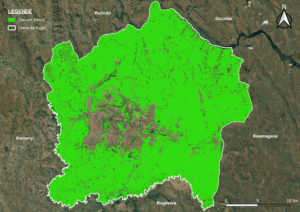
Map showing trend of urban forest decline in Kigali
“I remember we spent an entire week cleaning the shops and trying to salvage the few items that hadn’t been damaged by the floodwaters. Unplanned settlements have significantly contributed to the recurring flooding,” said Jean Baptiste Kigenza, a business operator dealing in beverages, food, and hygienic products, who lost over Rwf50 million in a single day in 2020.
From his business alone, the floods swept away food stock, beverages, cold rooms, fridges, laptops, his car, and other valuable property.
Aaron Musabyimana, a cyclist who transports goods across the Nyabugogo River bridge, added: “Flooding was much worse before the bridge was widened. Some passengers even lost their lives, and others were swept away by the river’s waters. As cyclists could not generate any income.”
The business community mentioned areas such as Nyamirambo, Kimisagara, and Gatsata as the origins of the flooding.
These areas are home to three forested hills in Kigali: Mount Jali in Gasabo District, Mount Kigali in Nyarugenge District, and Mount Rebero.
The degradation of the hilly terrains of Mount Kigali, Jali, and Rebero has significantly heightened the risk of erosion and severe flooding downstream, particularly in the Nyabugogo, Gatsata, and Nyabarongo valley areas according to Abias Maniragaba, an Environmental Economics Lecturer at the University of Lay Adventists of Kigali (UNILAK).
“Whenever a house was elected it meant a number of trees were cut on such hills. People were told to relocate from Gatsata, for instance, because settlement in the surrounding hill has created high-risk zones runoff water from the houses has caused flooding causing damages and claiming lives of people. Planting trees is one of the solutions,” he said.
For example, in 2020, police and local authorities in Nyarugenge District urged communities living around Mount Kigali Forest to report individuals involved in deforestation activities.
At that time, several people were caught cutting down trees in the protected forest.
Police also found a hundred of trees in their separate homes in Buhoro, Nyakabanda Sector, which they had cut in Mount Kigali Forest.
In 2015, Institute of Policy Analysis (IPAR), an independent, not-for-profit research and policy analysis think tank in Rwanda warned that businesses around Nyabugogo River, Gatsata and other water catchment areas in Kigali could face further losses due to flooding if no urgent actions are taken to address the problem.
The area used to face floods before the drainage was expanded
IPAR’s survey on how small businesses in Kigali are being affected by recurrent flooding, indicated that small businesses in the areas experience losses estimated at Rwf178.2 million annually in direct and indirect damages caused by floods.
Most of the more than 360 respondents in the survey were dealers in car spare parts, general merchandise or foodstuff.
It showed that 74 per cent of the affected businesses sell their damaged merchandise whenever flooded.
The survey showed that 75 per cent of the business premises could not be accessed by customers, while 38 per cent lacked access to electricity, among other things.
More than 80 per cent of the respondents said the flooding experienced in 2013 was the worst in the last three years.
Eighty-one per cent of businesses were affected by floods in 2013 and 2014.
The annual damage costs resemble 22% of the total net profit of the businesses in the area.
The survey shows that 71 per cent of 355 businesses took measures to protect their businesses against flooding through creating flood barriers, moving production inputs higher above the ground, creating ditches around the buildings and using waterproof building materials.
A total of 28 per cent businesses said the measures needed to curtail the effects of flooding were too expensive or no information on how to deal with it.
Cost of flood management
The City of Kigali expanded Mpazi drainage which passes nearby Nyabugogo bus terminal and also expanded two bridges on the drainage that flows into Nyabugogo River at the cost of Rwf7.7 billion.
“Think back to the flooding that once plagued Nyabugogo; the new bridges have effectively addressed those problems. Thanks to the improved drainage systems, we have significantly reduced the dangers and risks to citizens’ lives, as floods caused by natural disasters previously claimed lives,” stated Samuel Dusengiyumva, the Mayor of Kigali City.
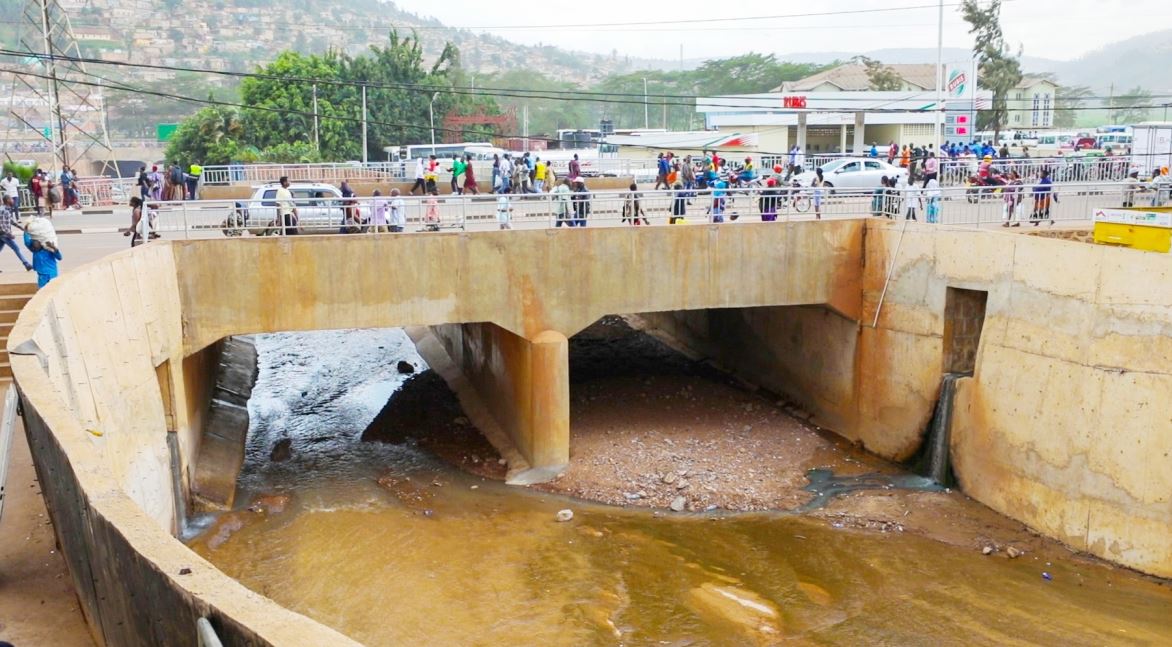
Expanded bridge to curb persistent floods in Kigali
The City of Kigali explained that the rise in the cost of building two bridges over the Mpazi channel, from Rwf2 billion to Rwf7.7 billion, to address flooding in Nyabugogo’s commercial area was caused by unusually high rainwater levels in Kigali, a consequence of climate change.
The water discharge into the drain increased [by about 70 percent] to 110 m3 per second from 65 cubic metres.
Nyabugogo Bus Terminal is also set to be revamped have big capacity and resilience to flooding at between $100 million and $150 million by 2027.
The city has spent Rwf2 billion to rehouse families that were being affected by Mpazi drainage flooding.
The city also faces flooding in 15 places such as Rwandex, Rugunga, Gikondo, Kinamba, Nyabugogo, Nyamirambo and others in different districts where it will install flood sensors and build bridges as well as culverts.
The city seeks to construct 66 drainages to manage the flooding from hills and unplanned settlements.
It in 2020 it was it was in need of Rwf30 billion for 40 drainages.
The city has invested over $1 million (over Rwf1 billion) in developing the Kigali ‘Stormwater Management Master Plan’ that is expected to be completed soon so as to mitigate floods in the capital.
“Nyabugogo frequently experiences flooding and erosion due to landowners cutting down trees to build houses and paving their compounds instead of planting trees or creating gardens. This accelerates runoff water, leading to significant damage,” observed Athanase Mukurarinda, an environment expert.
Effects of urban deforestation on public health
Experts have said there is impact of urban forests on urban health, air pollution, and respiratory diseases.

Kigali in drive to restore urban forest and green spaces
“This implies that illnesses aggravated by absence of urban forests such as Asthma, and others will increase,” Mukurarinda added.
Dr. Emmanuel Sibomana, the Director in charge of communicable respiratory diseases, tuberculosis, and other respiratory diseases at Rwanda Biomedical Centre said that there is not yet intensive research to know number of cases of respiratory diseases caused by deforestation in Rwanda.
However, he noted that, there is hypothesis that deforestation reduces quality of air leading to increase in respiratory diseases.
“It requires intensive research to determine these specific data on respiratory diseases caused by deforestation. However, in general, in 2023, at least 471,171 cases in Kigali were treated as they had signs of respiratory diseases. These cases make 9 per cent of all cases recorded in the whole country in that year,” he said.
Sibomana said that in 2022, health centres across the country received 11,501, 888 patients of whom 38 per cent had respiratory disease diseases.
“It is true that urban forests have decreased in Kigali due to settlement, housing and other infrastructure projects since air quality has decreased in our observation,” he said.
From 2012 to 2015 hospital admissions increased from approximately 1,682,321 in 2012 to 3,331,300 of which 13 per cent is caused by air pollution.
In Rwanda in 2012, more than 2,200 respiratory-related deaths occurred, of which 22% of death were children under 5 years old.
The estimated number of deaths from all types of air pollution in Rwanda in 2019 was 9,286.
“The numbers keep increasing and reforestation is one of solutions to help improve air quality,” he noted.
Today, 90% of people globally breathe polluted air and approximately seven million people die from air pollution related causes every year.
Air pollution costs the global economy $5 trillion in welfare costs annually and ground-level ozone pollution is expected to reduce staple crop yields by 26 per cent by 2030.
Rwanda, in 2023-2024, spent the total budget of $7.52 million on Tuberculosis and other respiratory communicable diseases strategic plan according to Rwanda Biomedical Centre.
Rwanda has developed a countrywide Air Quality Monitoring System which provides data on the quality of the air in 23 sites across Rwanda.
The system provides real-time Air Quality Index (AQI) for each station in both numerical and colour code format. It also highlights the dominant air pollutant which is responsible for air quality degradation during the reported period for each station.
In July, 2024, Rwanda Environment Management Authority warned that sensitive groups which include the elderly and people with pre-existing conditions such as diabetes, heart disease, and lung disease, are at risk as ongoing dry spells are exacerbating poor air quality.
It said that time that “parts of Rwanda were experiencing poor air quality, which can be harmful to sensitive groups.”
“We have a huge task to improve air quality in City of Kigali. The air has been losing quality,” said Samuel Dusengiyumva, the Mayor of Kigali City saying that interventions also include planting three million trees as part of nature-based solutions to manage stormwater and improve air quality.
These include planting trees and vegetation on hills, along rivers and drainages to help reduce speed of runoff water to avoid flooding.
The city is also rehabilitating and conserving wetlands since they retain and curb floods in addition to improving air quality.

Nyandungu eco-tourism park supplying fresh air after restoration
Currently five wetlands are under rehabilitation on 500 hectares after successfully establishing Nyandungu Eco-tourism park.
It is also preparing to create Kinyinya ‘Forest Eco- Park’ on the former Deutsche Welle Radio site.
The report was produced by Michel Nkurunziza, with the support of Pulitzer Center, an organization that supports journalists to fill the gap in international and domestic reporting.



Leave a Reply