
6 Knee-Strengthening Exercises to Add to Your Routine
Self.com
The knee is a super-important joint that helps you complete a variety of tasks—from walking to running to jumping—which is why incorporating knee-strengthening exercises into your fitness routine is a smart idea.
Now, you may think that knee-strengthening exercises only matter if you’re an avid marathoner or an elite athlete who puts their knees through the wringer. Not so. It’s a good idea for all of us to do knee-strengthening exercises, physical therapist Kate Bochnewetch, DPT, CSCS, founder of The Running DPT in Buffalo, New York, tells SELF.
If you’re looking to do knee-strengthening exercises at home–and perhaps you’re also curious to learn more about how to strengthen knees and why knee strength even matters—you’ve come to the right place. Below, you’ll find everything you need to know about knee strength, including the benefits of knee-strengthening exercises, what makes a good knee-strengthening exercise, and how to incorporate a few great moves into your routine.
Consider this your go-to guide on this incredibly important joint.
What are the benefits of strengthening the muscles around the knees?
See, the knee is “not necessarily the most stable joint,” Bochnewetch says. In an effort to make up for its lack of stability, the knee relies heavily on the surrounding muscles for support. These muscles include the quadriceps, a group of four muscles on the front thigh that help straighten out the knee and also assist in hip flexion, as well as the glute muscles, which play a key role in keeping the hips and knees aligned and controlling the knee in side-to-side movements.
Your quad and glute muscles need to be strong enough to properly stabilize the knee and keep it safe when it moves. And that’s where knee-strengthening exercises come in. By taking the time and effort to strengthen your knees—through both quad-strengthening exercises and glute-focused moves—you can boost your knee health and reduce your risk of injuring the joint.
Bottom line: Knee strength is crucial for overall knee health. And as we mentioned, it’s important for pretty much everyone. But knee-strengthening exercises for runners and other athletes whose sports involve high impact moves are extra critical, says Bochnewetch. Because these people are asking a little bit more from their knees (and bodies in general), it’s extra important to make sure their joints are strong enough for the tasks at hand.
What are the best knee-strengthening exercises?
The best knee-strengthening exercises target the supporting muscles of the knee, including the quads and glutes. It’s especially important to hit all the muscles of the glutes, including the gluteus medius, a smaller butt muscle that helps your legs move out to the side (a movement called abduction). “It’s a really important muscle when it comes to knee health because that’s the muscle that prevents your knee from caving in when you’re doing single-leg activities,” says Bochnewetch. Yes, that means running, walking, and stair climbing.
Unfortunately, the glute medius “tends to be fairly weak in the general population,” says Bochnewetch, which is why you should definitely incorporate moves that specifically target this muscle when designing a knee-strengthening routine.
Another tip, especially if you’re strapped for time? Pick compound exercises, like squats and lunges, that hit several different muscle groups at once instead of isolation moves (like donkey kicks) that focus on just one muscle group. The reason: Compound exercises provide more “bang for your buck,” says Bochnewetch, so you can incorporate more knee-strength work into your routine without adding tons of extra time.
Lastly, when doing knee-strengthening exercises, make sure to follow the concept of progressive overload, which is when you gradually and continually increase the intensity of your routine, by either adding more weight, increasing reps or weights, or reducing your rest time. This ensures you will continue to challenge yourself and improve your strength, says Bochnewetch.
One more quick note: If you’re looking for exercises for knee pain, such as runner’s knee exercises, it’s a good idea to talk to a physical therapist. Certain exercises may be contraindicated for certain types of knee pain and overuse injuries, so it’s always a good idea to get a personalized diagnosis and treatment plan if you think you have an injury.
How often should you do knee-strengthening exercises?
You don’t need to slot in knee-strengthening exercises every day in order to see results. In fact, Bochnewetch suggests doing knee-strengthening exercises just two times per week. Pencil them in alongside your usual leg workouts, or as a separate standalone routine, she says.
As a general rule of thumb, do each exercise for 8 to 12 reps and 2 to 3 sets. If you’re using weights, choose a weight that will allow you to perform reps at an intensity that feels between a 6 and 8 on difficulty scale of 1 to 10 (where 10 is the most challenging), Bochnewetch advises.
6 Knee-Strengthening Exercises
To get started with knee-strength work, try these exercises recommended by Bochnewetch.
You can pick two to three to add to your lower-body routine and switch it up over the weeks to shuffle through the list. Or do all of them at once for a complete quad- and glute-focused lower-body workout. (If you’re a beginner, pick just three to four moves for the full workout.)
However you choose to incorporate these exercises into your routine, make sure to do a warm-up first so that you don’t jump in with cold muscles. It doesn’t need to be elaborate; a simple 5- to 10-minute walk will do the trick. Or try this bodyweight routine.
Equipment needed: A pair of dumbbells. If these exercises are new to you, stick with bodyweight-only first and work your way up to adding weights once you’re comfortable with form.
Demoing the moves are Amanda Wheeler (GIFs 1 & 2), a certified strength and conditioning specialist and host of the Covering Ground podcast; Shauna Harrison (GIF 3), a San Francisco Bay–area trainer, yogi, public health academic, advocate, and columnist for SELF; April Nicole Henry (GIF 4), a strength athlete, mother, and wife who was born and raised in New York; Cookie Janee (GIF 5), a background investigator and security forces specialist in the Air Force Reserve; and Grace Pulliam (GIF 6), an aerial yoga and vinyasa yoga teacher in New York City.
- Single-Leg Deadlift
Stand with your feet together, holding a dumbbell in each hand in front of your thighs. This is the starting position.
Shift your weight to your left leg; while keeping a slight bend in your left knee, hinge at the hips and lean forward, bringing your torso parallel to the floor as your right leg extends straight behind you and the weights lower toward the floor.
Keep your back flat and core engaged. At the bottom of the movement, your torso and right leg should be almost parallel to the floor, with the weight a few inches off the ground. (If your hamstrings are tight, you may not be able to lift your leg as high.)
Keeping your core tight, push through your left heel to stand up straight and pull the weight back up to the starting position. Bring your right leg back down to meet your left, but try to keep the majority of weight in your left foot.
Pause there and squeeze your glutes. That’s 1 rep.
Do 8–12 reps on the same side, then switch sides and repeat.
This exercise recruits all the glute muscles, including the oft-neglected gluteus medius, which helps prevent the knee from caving inwards. Beginners can do this exercise using bodyweight only.
- Step-Up
Stand in front of a sturdy box or step, hands at your sides and feet hip-width apart.
Step onto your box with your left foot, then follow with your right foot. As you step, focus on using the foot on the box to lift yourself up, rather than pushing off the floor with your trailing foot. Pause for a moment when both feet are on top of the box, hip-width apart.
With control, return your left foot to the floor, then step your right foot to the floor to return to your starting position. This is 1 rep.
Continue to repeat on the same side for 8–12 reps, then switch sides and do another 8–12 reps.
This compound movement helps strengthen both the quads and glutes, two important muscle groups that support the knee.
- Split Squat
Get into a staggered stance with feet hip-width apart and one foot positioned several feet in front of the other, with a dumbbell in each hand.
Brace your core and bend both knees to lower your body into a lunge (or split squat) until your front thigh is parallel to the floor. Make sure to keep your core tight, spine straight (your torso may need to lean slightly forward to achieve this, and that’s fine), and shoulders back (not hunched up or rounded forward).
Push through the heel of your front foot as you straighten that knee and return to standing. This is 1 rep.
Do 8–12 reps on the same side, then switch legs and repeat.
This single-leg squat variation, which is basically a stationary lunge, is great for strengthening your quads and glutes, says Bochnewetch. It also recruits your hip muscles for stabilization. Beginners can do this exercise with bodyweight only.
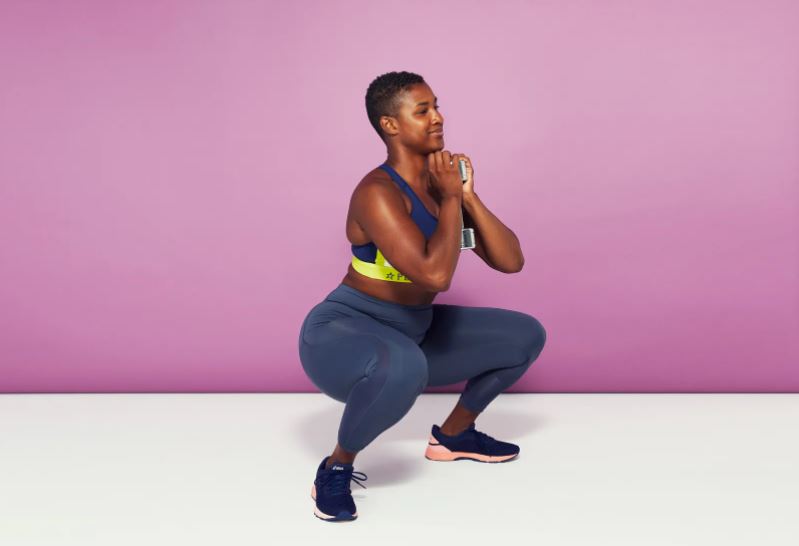
- Eccentric Goblet Squat
Stand with your feet about shoulder-width apart, toes slightly turned out. Hold a dumbbell at your chest, with both hands gripping one end. This is the starting position.
Bend your knees and push your hips back as you lower into a squat. Think about keeping the majority of your weight on your heels to better activate your glutes and hamstrings.
Drive through your heels to return to standing and squeeze your glutes at the top. That’s 1 rep.
Do 8–12 reps.
To increase the knee-strengthening benefits, elevate your heels on top of a weight plate or a 1-inch-thick book so that more load is placed on the front of your body. This will help strengthen the tendons, ligaments, and muscles that surround the knee.
- Lateral Lunge
Stand with your feet together, holding a dumbbell in each hand. You can either hold the dumbbells racked at your shoulders (as shown) or down by your sides.
Take a big step out to the right with your right foot. Hinge forward at the hips, push your butt back, and bend your right knee to lower into a lateral lunge, keeping your left leg straight. If you started with the weights by your sides, they should now frame the right leg.
Pause for a second, and then push off your right foot to return to starting position. This is 1 rep.
Do 8–12 reps on the same side, then repeat on the other leg.
The lateral lunge works the quadriceps muscles, outer thigh muscles, and glutes, with more of a focus on the glute medius than regular forward or reverse lunges. It also gives you a nice inner-thigh stretch.
- Banded Glute Bridge
Lie on your back with your hands at your sides, knees bent, and feet flat on the floor hip-width apart. Loop a resistance band around your thighs, just above your knees. This is the starting position.
Squeeze your glutes and abs, and push through your heels to lift your hips a few inches off the floor until your body forms a straight line from your shoulders to your knees. Hold this position for a second, making sure to maintain tension in the band so your knees don’t collapse in toward one another.
Slowly lower your hips to return to the starting position. This is 1 rep.
Complete 8–12 reps.
The glutes bridge targets the glute muscles. Adding the resistance band makes it more of a challenge for the glute medius and other muscles on the outer hips as you engage them through the entire motion; plus, this effort will keep the knees from caving in, thereby keeping the correct muscles engaged.



Leave a Reply