
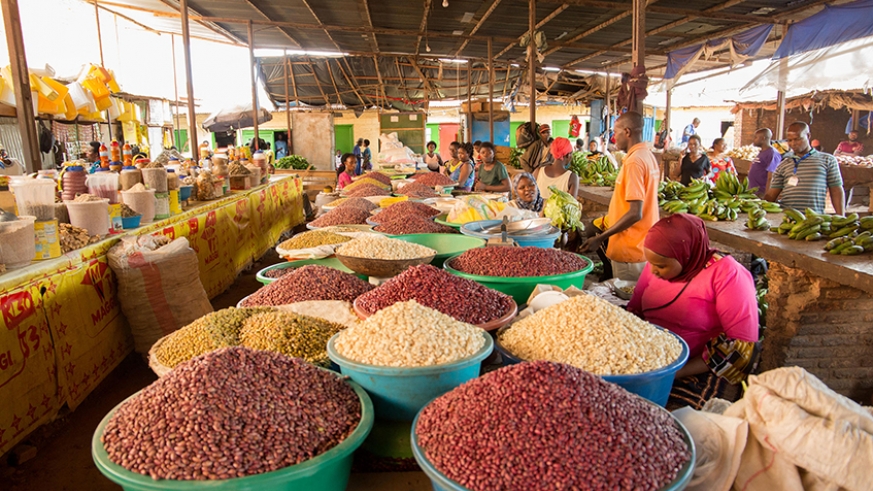
MINAGRI links food price stability to farmer productivity as drought and seasonal shifts affect markets
By Elias HAKIZIMANA.
Agriculture and Animal Resources Minister, Dr. Thelesphore Ndabamenye, has emphasized that stabilizing food prices in Rwanda largely depends on farmers maximizing production and efficiently using available agricultural inputs, despite ongoing climate-related challenges.
Speaking during a talk show on Radio Rwanda on April 27, 2026, focused on “The role of farmers in mitigating the impact of crop price hikes on markets,” Dr. Ndabamenye said recent agricultural seasons recorded overall positive performance in crop yields, even with the effects of climate change.
He noted that crop productivity increased between 1.5% and 4.8% across major staples.
“Maize production increased by 1.1% in seasonal yield, Irish potatoes increased by 3.3%, while cassava recorded a significant rise of about 5%. Vegetables also increased by around 1.5%, and rice by about 2%,” he said.
He added that vegetables remain a key market-driven crop, with about 80% of production going to markets and 20% consumed at household level.
However, he acknowledged that beans production declined by about 0.5% in some parts of the country due to drought conditions experienced in September and October 2025, though he noted the impact remains manageable.
Farmers at the center of price stability
Dr. Ndabamenye stressed that farmers play a central role in stabilizing prices through proper use of fertilizers, pesticides, and full utilization of arable land.
He explained that crop distribution patterns vary by commodity: maize has 42% marketed and 43% consumed at home, rice has 81% marketed and 17% consumed at home, while Irish potatoes have about 50% marketed and 20% consumed at household level. Beans, he noted, remain largely a subsistence crop with 46% consumed at home and 22% sold.
He further indicated that Season B remains promising, with about 65% of beans already planted, while Season C (June–August) is expected to further strengthen market supply and reduce pressure on prices.
“Prices move in line with available supply. The first solution is to maximize production using all available capacity so that we are better prepared for unexpected shocks,” he said.
Monitoring market prices and seasonal pressures
The minister said government continues to monitor food prices in collaboration with the Ministry of Trade and Industry (MINICOM), Ministry of Finance and Economic Planning (MINECOFIN), and local government authorities.
He noted that maize prices have remained stable and even dropped by about 9% between February and May 2026. However, Irish potato prices increased by 10–15% due to seasonal shortages, while sugar and rice recorded an average increase of about 3% linked to import dependency.
He expressed optimism that Irish potato prices will drop once new harvests enter the market in June.
Expanding irrigation and marshland farming
To prepare for Season C, Dr. Ndabamenye said the government is encouraging irrigation expansion and better use of marshlands and hillside farming.
He highlighted ongoing irrigation initiatives in districts such as Kayonza and Ruhango, aimed at supporting continuous production beyond rain-fed agriculture.
“We are encouraging farmers to irrigate and cultivate marshlands and hillsides for crops like beans, Irish potatoes, and vegetables. When arable land is fully used, production increases and prices stabilize,” he said.
He added that better use of marshlands for vegetables and potatoes could significantly reduce market shortages and price volatility.
Local government and farmer perspectives
Rutsiro District Mayor, Dative Kayitesi, said farmers in her district have adapted to seasonal farming cycles, producing maize, beans, soybeans, cassava, and Irish potatoes across Seasons A, B, and C.
She noted that Irish potato prices have risen from 270–350 RWF/kg in Season A to 450–500 RWF/kg currently, while beans have increased from around 800–1,000 RWF/kg to 1,200–1,300 RWF/kg.
“We are encouraging full use of arable land, including marshland development for tomatoes, eggplants, and other vegetables to complement bean production,” she said.
Farmers also called for improved access to irrigation infrastructure, affordable fertilizers, and quality seeds. A farmer from Gakenke District highlighted irrigation gaps and food insecurity concerns, while a potato farmer from Musanze argued that high input costs should be considered in pricing structures.
Government response and food diversification push
Responding to farmer concerns, Dr. Ndabamenye encouraged diversification, including increased production of sweet potatoes and vegetables to strengthen household food security.
He said sweet potatoes will be promoted in marshlands between May and July to help bridge seasonal food gaps.
“We encourage farmers to dedicate land to sweet potatoes, vegetables, and Irish potatoes so that no land is left uncultivated,” he said.
He also urged better land use planning, cautioning against conversion of arable land into non-food uses such as tree plantations in areas facing food demand pressures.
theinspirerpublications@gmail.com




Leave a Reply